

Peterhof's 1902 Gala Performance
The Perils of putting on a Romanov Show

(All pre-1918 Russian Dates are given Old Style)
Introduction
In the summer of 1902, the Russian nobility were expected to leave their Crimean estates to attend a royal wedding, including a ballet gala performance. Location of the ‘paradnii spektak’l:’ Peterhof.
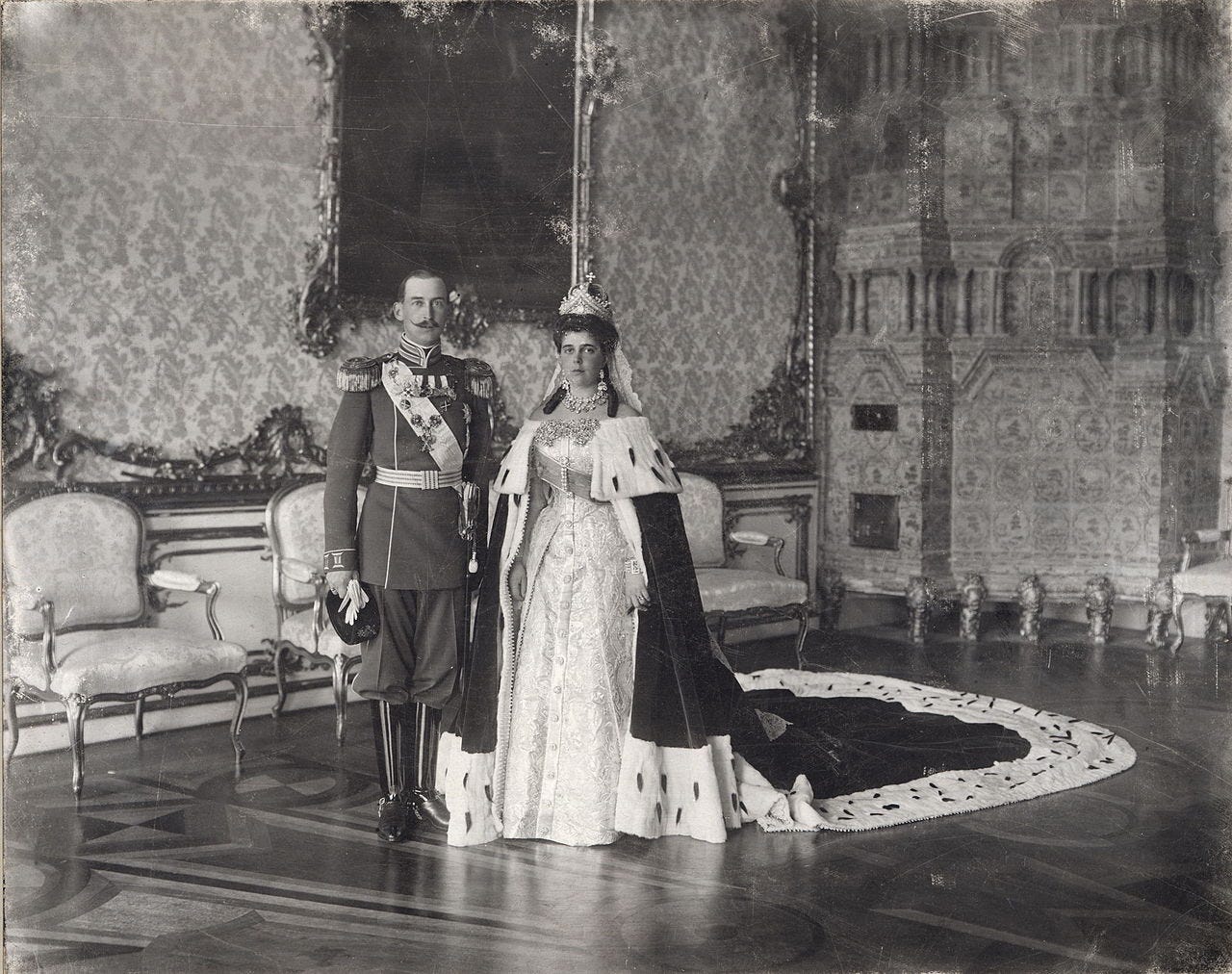
The happy couple were the Grand Duchess Elena Vladimirovna and Prince Nicholas of Greece. The 30-year-old groom was an uncle of Prince Philip, Duke of Edinburgh (1921-2021). The bride was the 20-year-old daughter of Vladimir Alexandrovich, art connoisseur brother of the late Alexander III, and Marie of Mecklenburg-Schwerin, Russianised as Maria Pavlovna. As Romanovs, Elena and her older brothers, Kyrill, Boris and Andrei (Matilda Kschessinskaya’s partner) had been born into privilege, but unlike other members of the multi-branched family, they were reluctant to give back. They enjoyed a sybarite lifestyle and Elena had a reputation of being spoilt. After two engagements came to naught, her market value dwindled, her status notwithstanding. The first of these disappearing men was Prince Max of Baden. Not long after a second arrangement fell through, with the future King Albert of Belgium, the Greek-Danish Prince Nicholas proposed in 1900, saving her reputation. His mother, Queen Olga, was born Romanov too, and Elena had known Nicholas since childhood. Nicholas, however, was a third son with neither prospects nor fortune. It took Elena’s overtly ambitious mother two years to consent to the marriage, probably upon realising that more appealing options were not to follow. Hence the gala ballet performance; a major part of the wedding festivities.
In the meantime, Elena enjoyed some innocent yet noteworthy attention. On 17 March, Leonid Sobinov sang in the Von Dervis Mansion, amidst a sizeable selection of Imperial Fabergé Eggs. The recital was organised by none other than Tsarina Alexandra Fyodorovna, to mark the first exhibition of her ovoid treasures in Russia. Quasi-indifferent to all attention, the tenor declared with a mesmerised look that he only sang for Elena. Heartthrob Sobinov, a married father, wooed the actress Elizaveta Sadovskaya at the time, trading her in for the dancer Vera Karalli later. He must have had a weak spot for dark-haired women.
Peterhof
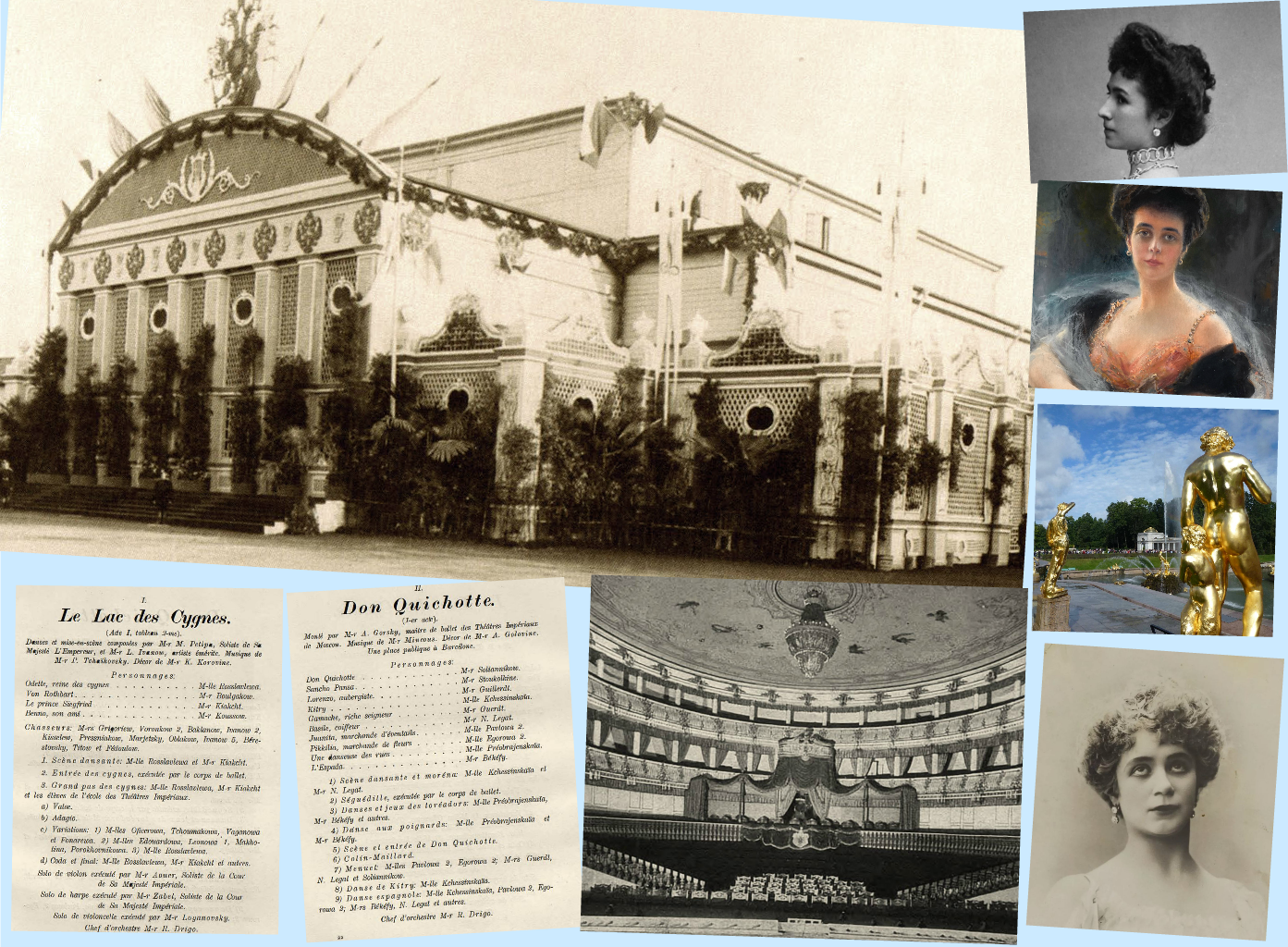
Founded by Peter the Great, the Peterhof palace complex is a baroque-style Eden that directly borders the Finnish Gulf. The World Heritage Site has extensive grounds, dotted with palaces, fountains and pavilions – it ranks high among the world’s grandest places. No wonder the Romanovs hosted a good deal of their events there. Shows were organised by the Imperial Theatres. By the end of the 19th century, these were either given in the open air theatre on the Olgin Island, or in the Imperial Summer Theatre, often (and hereafter) referred to as the Peterhof Theatre. Historian Irina Paschinskaya asserts that performances were prepared for both stages, in case of bad weather.
The evening for Elena and Nicholas took place inside, on 19 August. The Peterhof Theatre was situated a 15-minute walk from both the Olgin (southwards) and the Great Palace (westwards). Its history started back in 1836 when Nicholas I ordered the architect Iosif Charlemagne to transform part of a regiment base into a theatre. A year on, the building was inaugurated on a freshly created address, Theatre Square. Performances were already hosted while decorations were still being finished and the surrounding streets laid out.
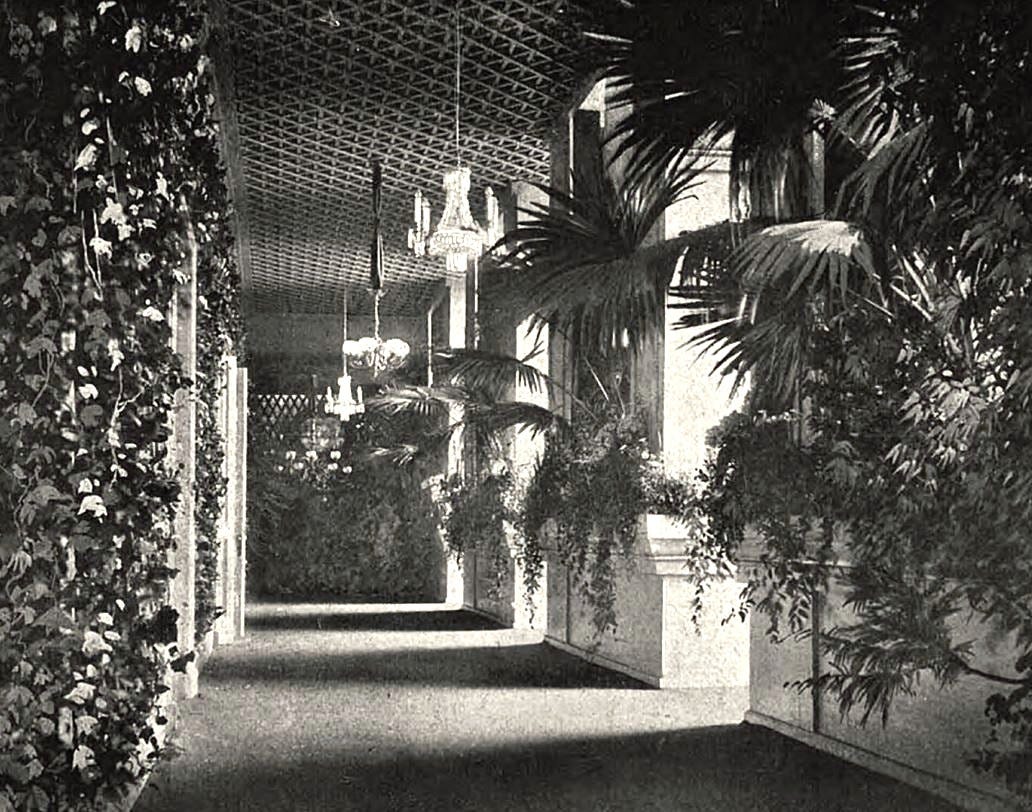
Historian Vitaly Guschin’s description is as follows: ‘...The theatre building, wooden with an iron roof, three-tiered, was done in the classical style. The façade was most colourful and faced the Lower Park: eight Ionic columns supported the semi-circular pediment, adorned with a lyre in relief. [There were] burning torches, masks, [and] guirlandes. The auditorium was astonishing in its beauty: seats upholstered with red velvet, tiers embellished with carvings, balconies, a spectacularly decorated stage, tapestries, curtain and bright lamps that lit the 600-seat auditorium, [it] reminded one of the Alexandrinsky Theatre ...’
In 1857, the theatre was refurbished and its capacity enlarged. Electricity was installed in 1894, for the gala performance that celebrated the marriage of Alexander III’s daughter Xenia and the Grand Duke Alexander Mikhailovich. For that occasion, Marius Petipa created The Awakening of Flora.
Performance Preparations
The court had required no premiere for Elena’s wedding, following the same course as the year before, when the tsar’s youngest sister, Olga Alexandrovna, got married. A play from 1890 was selected then: Chekhov’s A Marriage Proposal, a work Alexander III had enjoyed. The gala was abruptly cancelled when The Kaiser’s mother died. Born Victoria Princess Royal, she was the eldest daughter of Queen Victoria and so an aunt of the Tsarina. Afterwards, Vladimir Teliakovsky noted that the choice of the play was criticised. He did not go into detail, but the piece questioned marriage as means to connect wealth and money rather than love. Apparently, no one at court had stepped forward to point out the distressing aptness, since Olga had been coerced into marrying Prince Peter of Oldenburg1 - whose homosexuality was an open secret to all but the young and naive Grand Duchess. In her memoirs, Olga graciously explained that she agreed to a marriage that allowed her to stay in Russia, but the play was a farce and there was a farce at play.
At the time of the Russo-Greek nuptials, Imperial Theatre Director Vladimir Arkadyevich Teliakovsky had been in his position for a year. The former Horse Guards Colonel, 42, was an avid diarist, having produced some 16.000 pages. Needless to say that this massive document provides terrific insight into the epoch’s artists and circumstances. According to the diary, Teliakovsky met with a mixed Moscow/St Petersburg team on 29 July in preparation for the event. Present were assistant manager Vasily Arshenevsky, Moscow’s 1st Ballet Master Alexander Gorsky, régisseur Nicolai Aistov, the painter Alexander Golovin, the official Nicolai Petrov and Nicolai Berger, head of the technical staff. It was decided to go for scene 2 of Swan Lake (the first Swan Scene) and the Barcelona Square Scene from Don Quixote (of La Mancha), the major part of Act I. Selecting repertoire only weeks before such an occasion seems late, but the decision to give A Marriage Proposal was made equally tardy.
While Swan Lake was being finalised, Aistov brought up Matilda Kschessinskaya’s hold on Odette/Odile. The notorious ballerina, who had a son on 18 June, had taken over the dual role from Pierina Legnani in a joint debut with Nicolai Legat last year (4 Apr 1901). Kschessinskaya had been next in line for Odette/Odile, neither asking for it, intrigued by its artistic values, nor appropriating it.2 In her later memoirs, she does not mention Swan Lake at all, as opposed to the other ballets she inherited from Legnani, The Hump-backed Horse and Camargo.
That autumn, Carlotta Zambelli guested at the Mariinsky, starring in Coppelia, Giselle and Paquita. When she expressed an interest to add Odette/Odile to that list, Kschessinskaya let it be known from her holiday address that that was not going to happen, despite her apparent lack of interest. The diva had had a rocky summer following the Camargo scandal – she had refused to wear the prescribed farthingale – which resulted in director Volkonsky’s resignation and a plummeting of her popularity. Acting up with Swan Lake was Kschessinskaya standing her ground, her hissing ‘I’m still here.’
Because of these machinations, Swan Lake was not scheduled for 1901/02, but the Ball Act was given afterwards, in a Tsarskoe Selo gala (in honour of the French president’s visit). It saw Olga Preobrazhenskaya’s debut as Odile. By that time, Kschessinskaya was eight months pregnant and Odile was an olive branch, a political move. Moreover, Matilda Felixovna did not perceive Preobrazhenskaya as a threat.
Then there was Don Quixote (of La Mancha). Gorsky’s ballet had premiered at the Mariinsky on 20 January. After a mere four performances, the españolada could still be considered a novelty. The Vladimirovichi were no newbies to Don Quixote: Grand Duchess Elena and her parents had attended the farewell benefit of Enrico Cecchètti (27 Jan). This implies that Elena could have suggested the ballet herself for the wedding.
When it came to casting, ballerinas had top priority. Teliakovsky planned to reprise the force from the Tsarskoe Selo gala, Preobrazhenskaya and Moscow’s Lubov Roslavleva - who had danced Act II of The Hump-backed Horse. In this scenario, Preobrazhenskaya, who was further removed from Kitri than Odette/Odile, was to have her first shot at Odette. Kitri would go to the gifted Roslavleva, who had danced it in Moscow. During the Lent break, she had toured Monte Carlo with a mixed Moscow/Petersburg troupe of dancers. Dancer/ballet master Alexander Shiryaev was on the tour as well, and he perceived Roslavleva as lazy, thinking she sheerly thrived on talent, but did acknowledge her great success there. Trying some perspective: lots of dancers behave piano on small tours, and perhaps Roslavleva was no exception, leaving classes before the allegro section, pointing hastily to her (tired) legs and blowing kisses to the teacher on her way out.
When the Minister of Court, Baron Fredericks - the confidante of Their Majesties - asked which ballerinas would participate, it turned out that no one had thought of Kschessinskaya, in her capacity as a dancer as opposed to role-owner. Maternity leave sufficed to erase her from the collective memory there. The mistake was Aistov’s, who should have brought the matter to Teliakovsky’s attention. Kschessinskaya was easy to distribute. Aside from ‘being’ Odette, she was Gorsky’s Kitri at the Mariinsky too. The director sent Petrov to her with an invitation. But how realistic was the possibility of Kschessinskaya’s comeback on 19 August?
Kschessinskaya
In the meantime, Kschessinskaya was tucked away at her dacha in Strelna. She does not hold back on giving birth in her memoirs. We read that the delivery pains were excruciating, how both she and the child almost died, and that she experienced a violent fever, followed by a period of weakness. The Grand Duke Vladimir, the baby’s grandfather, was of great comfort to her in those days - or so she wrote. By the time the gala performance was imminent, Kschessinskaya had been spotted at a play. This had come to Teliakovsky’s attention and therefore considered her to be in good health. But being an audience member is one thing, fit to dance another.
Teliakovsky let Petrov assure Kschessinskaya there was still plenty of time. He also let Petrov remind her that ‘Kitri’s contribution to Act I is not big.’ Quite peculiar. Did Kitri’s part become extended later? This sounds improbable. The division of dances remains virtually unchanged, and it is hard to believe the imperial-day Kitris sort of marked their way through them. A good example is the famous variation, found in the programme as the ‘Danse de Kitry.’ Kschessinskaya described it as follows: ‘... I danced the classical variation sur les pointes, using castanets merely to stress the beat lightly. My dance was performed to an extraordinary rapid rhythm. I executed pirouette after pirouette ...’
Kschessinskaya’s writings are not the world’s most truthful, but she had no motive to tweak a dance description, and so it is safe to assume that the variation did not change much - safe for the ‘head-kick sissonne;’ credited to Maya Plisetskaya.2 Credibly, Teliakovsky viewed Kitri’s first act participation in the context of the large multi-act ballet that Don Quixote was. It proves that his knowledge of ballet was limited, at least up until the early 1900s.
After the official invitation, Teliakovsky contacted Kschessinskaya himself (31 Jul). The diaries of the director show a man gradually learning to deal with this fascinating, capricious and often downright immoral artist. A cordial relationship was established, hiccups notwithstanding, and while Teliakovsky tried to put her in her place a fair few times over the years, he remained somewhat awed by her. From his memoirs: ‘... a Prima Ballerina in every respect - authoritarian, clever, shrewd and influential ...’ This Prima Ballerina told her director how pleased she was with the invitation. She promised to give him her answer on 10 August.
While Kschessinskaya hurried back to the barre, Teliakovsky returned to other matters, among which Don Quixote’s title role. Gala casting seemed driven by the intention to showcase many different artists. Alexei Bulgakov was a more relevant Evil Genie than Don Quixote, so there he was. Now Aistov tried to put himself forward; his second gala mistake. In itself, Aistov’s attempt would not have been entirely out of place, for he performed figures of authority like Rajah Dugmanta in La Bayadere, the Pharaoh in Pharaoh’s Daughter and Don Lopez in Paquita. But whether he had the charisma to pull off the Don (and those other roles) was irrelevant, for there already was a second cast: Nicolai Soliannikov. Teliakovsky diarised he thought better of Soliannikov’s Don than Bulgakov’s (30 Jan, 21 Mar 1902), and he also preferred Vasily Stukolkin to Enrico Cecchètti as Sancho Panza. But Soliannikov, who had played the role twice, was on holiday. Aistov had neglected to contact him on his own initiative. Now Soliannikov was retrieved from whatever pool he found himself in on Teliakovsky’s order. The director did not pardon Aistov for his glitches. He was replaced as régisseur by Nicolai Sergeyev a year later.
Kschessinskaya & Roslavleva
Naturally, Teliakovsky was anxious to find out whether Kschessinskaya would resolve to go on stage, but when Arshenevsky offered to inquire, he forbade him to do so. It would not look strong. In the end, Kschessinskaya danced, of course. In her view, letting others do a royal performance meant jeopardising her relation with the Tsar, who kept treating her well after their youthful liaison. But she also wrote Teliakovsky a letter, begging him to give Swan Lake to Preobrazhenskaya and rescind his invitation to Roslavleva. There are earlier examples of Kschessinskaya’s problems with the Moscow ballerina, whose competition she genuinely feared. Now, while trying to get back in shape, Kschessinskaya must have felt particularly vulnerable. It was another example of how she considered Preobrazhenskaya less of a rival.
Besides, if Teliakovsky obliged her, there could be an extra advantage to boot: Preobrazhenskaya might be fatigued after her first Odette, so when returning later for the Street Dancer, Kschessinskaya’s own chance to come off well increased, even if her performance should turn out a little shaky. Preobrazhenskaya’s preferred pale make-up (for the Street Dancer) would do the rest. As any fresh-mother dancer can tell, post-birth muscles can let you down on the spot. Kschessinskaya was undoubtedly aware of that danger and tackled the situation in her own way: when being imperious didn’t work and the time for scheming had passed, begging was not beyond her. Poor Preobrazhenskaya. While rehearsing The Street Dancer, she must have begun to work on Odette as well, knowing it could be a waste of time, should Kschessinskaya not get her way.
Teliakovsky mentioned Kschessinskaya’s demagoguery on the day of the dress rehearsal (15 Aug). He resolved not to grace it with an answer, which is why a proud Kschessinskaya, whom he saw that day (aside from seeing her dancing), did not speak of it in turn - here were two creatures of expediency working it.
Roslavleva was on. She had seven performances of Odette/Odile under her belt that season - but in Gorsky’s staging. It is unclear how much Gorsky deviated from Petipa and Ivanov in his first Swan Lake, which had premiered on 24 January 1901. Elizabeth Souritz: ‘... while transferring the Petipa/Ivanov production to Moscow, he partially reworked the dances ... ‘
But reviews diverged so much that they could describe entirely different ballets - or so Teliakovsky asserted with a satisfaction not unlike Diaghilev’s later (where opinions conflicted, publicity was not far and ticket sales would go up, or so the Ballets Russes founder surmised). From an artistic point of view, Roslavleva should have welcomed the opportunity to do the undiluted Ivanov.
Although Kschessinskaya singlehandedly redefined the magnitude of the word ‘difficult,’ she certainly was no patent holder. On 30 June, Roslavleva had not shown up at the dress rehearsal for an earlier gala at Krasnoe Selo - one on the brink of oblivion. It formed a part of the Italian King’s state visit. Trifling with the military administration, Roslavleva insisted on a higher additional fee than was first agreed upon, something she would not have dared with the court, which paid her general salary (Sergey Belenky). Grand Duke Vladimir, involved in the preparations, announced - surely belted - that she need not come back at all. Teliakovsky was surprised by Roslavleva’s actions; she knew what was at stake with the Tsar hosting Victor Emmanuel III. But on 1 July, the day of the performance, everything appeared to have been settled. Of course, Roslavleva was reprimanded. She also cannot have escaped penning an apology to the grand duke, for how else could she have danced at his daughter’s wedding a few weeks on?
During ‘Krasnoe Selo,’ Teliakovsky learned there were more clouds on the horizon. The Tsar told him to keep the preparations for 19 August low-profile: a cancellation was pending. The year before, it was the death of the Kaiserin and now her brother, King Edward VII, was in a critical condition. He suffered from appendicitis, an affliction generally not treated operatively at the time. His coronation had to be postponed and Europe held its breath (needless to say, he made a full recovery). Then there was the poster. While in the train to minister Baron Fredericks, Teliakovsky was dismayed at finding out there were spelling and credit errors. Neither Petrov, who had ordered the poster nor Arzhenevsky, who handed it to the director, had bothered to check the clerk’s work. For now, it was too late to correct it. The minister’s moustache must have twitched when he read that Swan Lake had Tchaikovsky, but Don Quixote had no composer, and Barcelona was renamed.
Innovations & Tsarskoe Selo
At this gala performance, Swan Lake was to be presented in a novel way: Ivanov’s choreography would not be performed in front of the late Bocharov’s backdrop, but to that of the modernist Korovin. There is also a surviving note by Teliakovsky (1 Aug 1902) to his Moscow deputy Nicolai von Bohl, concerning the use of Swan Lake’s men costumes.
This was, of course, not engineered to make Roslavleva feel more at home. Following was the case: when Teliakovsky had come to know the Mariinsky repertoire, he abhorred the productions. Coming from the contemporary-oriented Moscow, Petersburg’s theatre culture felt anachronistic. At the Bolshoi, Korovin and Golovin had designed Gorsky’s first Swan Lake.3 Barring backstage reactions - the designs had elicited waves of protest from traditional bureaucrats and artists alike - Teliakovsky noticed that the audience, somewhat puzzled, took to them nonetheless and that everybody ‘of some intelligence’ embraced the work.
While Teliakovsky was going about setting changes, a bit of luck had come his way. Royal luck: on various occasions, the Romanovs had expressed themselves favourably about his preferred artists. A year before, Korovin had told Teliakovsky how the Grand Duke Vladimir praised his sketches for Don Quixote, exhibited at the Academy. Teliakovsky surmised that this was the first time theatre designs had been shown at the arch-conservative institute. Moreover, during Cecchètti’s benefit, the Tsarina had admired a poster by Golovin. Small talk on art had ensued, and the Sovereign complimented Korovin’s work as well. This left Teliakovsky convinced that where modern art and ‘art integrity’ were concerned, the royal couple and he were on the same page.4 He now had ammunition to present contemporary-styled sets in a court performance, and so let his royal patrons sample the looks he envisioned for future Mariinsky productions.
Teliakovsky had set out with the 9 May gala in Tsarskoe Selo. There, in the Chinese Theatre, Korovin’s backdrop hung for The Hump-backed Horse and Golovin’s for Swan Lake. Now he continued his policy. On 29 July, he mentioned needing an estimate for redesigning and executing of the Swan Lake and Don Quixote sets for the upcoming gala (the wedding present for Elena and Nicholas).
The Gala Performance
On 16 August, the day of the wedding, Teliakovsky had to attend the ceremonial dinner. Two days later, he went to Peterhof to supervise the last technical rehearsal. He commented on the flower arrangements and recorded that the lighting on the fountains operated well. From this we learn that the theatre boasted stage fountains (outside waterworks would not lay within Teliakovsky’s responsibilities) and ran before and after the performance. These were connected to the extensive pipe system that fed the fountains of the Great Palace. The director expressed some disappointment with Golovin for having reproduced his ‘old’ Don Quixote set - apparently, he thought to have paid for a fresh design. Then the 19th arrived. Teliakovsky noted a two-hour rehearsal without costumes from 2 to 4 and then gave a detailed account of the evening:
‘... The gala performance was to start at 9. The audience began to take their seats as early as 8.30. At 8.15 the lighting was on and the fountains started to run. However, the lights were not fully operable, there was flickering, and despite the necessary tests the fountains were never fully lit ... [here Teliakovsky goes into detail as to how that could have come about, elaborating on ego problems in the lighting department. The culprit was found and let go] ... The Tsar arrived at 9 in the theatre. The royal box was extended on two sides because so many family members attended ...’
The director then fumed that the manager, Vladimir Starzhenetsky-Lappa (‘Lappa’), insinuated he had used cheap fabric for the extension.5
Teliakovsky: ‘... Our complete royal family was present, apart from the Tsarina Alexandra Fyodorovna, [Elena’s brother Boris, who was in America. Also in attendance were] the King and Queen of Greece with three sons, Duchess Maria Alexandrovna of Edinburgh and her daughter, Anastasia Mikhailovna of Mecklenburg-Schwerin [sister to Sergei Mikhailovich, the third member of Kschessinskaya’s grand-ducal ménage] her daughter and the Prince of Denmark. When the Tsar appeared in the royal box, the Greek Hymn was sung [in honour of the groom and his family] ...’
The orchestra was in place, led by giants such as concert master Leopold Auer and harpist Albert Zabel under the baton of Riccardo Drigo. Then the curtain went up on Swan Lake. Teliakovsky observed that Roslavleva enraptured everyone with her dancing. Below Roslavleva on the cast list was Georgy Kyaksht, another rogue, in his first Siegfried. He would not reprise the role at the Mariinsky, because Nicolai Legat remained first cast, but he danced Basilio that evening. Alexei Bulgakov played the Evil Genie and Benno was Ivan Kusov, by then a stalwart interpreter of the role. Among the Little Swans were Agrippina Vaganova, Olga Chumakova - Legat’s wife - and Ekaterina Ofitserova, all artists with variations and solo parts on their CVs.
Ten to one Kschessinskaya kept an eye on Roslavleva, lurking from behind one of Korovin’s broadly stroked wings while making tendus to warm up – witnessing how Lubov Andreyevna’s Odette nestled herself elegantly in Kyaksht’s arms, only to drop into Kusov’s, moments on. Kschessinskaya did not elaborate on the evening in her memoirs, she simply recorded that she was able to do it (without falling apart).
After Swan Lake, there was a 40-minute break until the curtain rose on Don Quixote’s Barcelona Square. Behind Kschessinskaya, Legat and Soliannikov were Preobrazhenskaya and Alfred Bekefy as Espada. Pavel Gerdt acted Kitri’s suitor Gamache, Stanislav Gillert her father, Lorenzo, while Anna Pavlova and Lubov Egorova interpreted the sellers Juanita and Piccilia - today two ‘unemployed friends.’ Lesser ensembles have been encountered at weddings. Teliakovsky recorded that Don Quixote was very well received: the Tsar told him that he found it exemplary danced, and how the dancers clearly enjoyed themselves.
‘... The Dowager Empress Maria Fyodorovna praised the performance too. The Tsar asked to see the designers Korovin and Golovin. When I entered the public foyer […] everybody congratulated me. Even those who never attend […] were delighted with Don Quixote ...’ (Teliakovsky).
After exempting Tchaikovsky’s score, Teliakovsky treated Swan Lake to a snide comment: ‘... boring production by Petipa ...’ Although Ivanov’s work was shown, Petipa’s name preceded that of the late 2nd Ballet Master in the programme - an effort of the éminence grise to draw credit to himself. How not to confuse a genius with a saint. In line with his ideas on the version, Teliakovsky did not record compliments on Swan Lake, which were undoubtedly paid as well.
‘... Grand Duke Vladimir came twice on stage to express his enthusiasm about both production and performance. The Grand Duchesses Maria Pavlovna and Elena Vladimirovna [the bride], congratulated me on an in every way successful endeavour. […] ‘the royal box’ was satisfied. I [myself] went on stage after the performance [too] and thanked Roslavleva, Kschessinskaya and Preobrazhenskaya. Despite the hassle of getting the three ballerinas to perform together, everything turned out fine ...’ (Teliakovsky).
The day after, Vladimir received a theatre delegation in his ‘Florentine’ palace on the Neva bank. During the baise main, approval was repeated. In a funny passage, Teliakovsky chided the young commander of the Life Guard Hussars, Prince Pavel Engalychev, who praised Don Quixote, but thought Swan Lake’s music to be a bit melodramatic. Teliakovsky, a progressive who obviously did not care for some independent taste, ascribed the remark to youthfulness and the general lack of art education.
The director met Vladimir and Maria Pavlovna again on 8 September at the Mariinsky, where the couple attended Raymonda, led by guest Ekaterina Geltser and Sergei Legat. They repeated their compliments on the gala performance.
On 13 October, Don Quixote of La Mancha was billed at the Mariinsky. Kschessinskaya shone as Kitri in her first public performance in eight months. Teliakovsky noted how she, Pavlova and Trefilova were received very well, but that Preobrazhenskaya’s reception was rapturous. Kschessinskaya cannot have been pleased.
Ever After
After the wedding, Elena Vladimirovna settled in Greece with her husband, in surroundings far less lavish than the world called Romanov. Hiccups on this account must have occurred, but the marriage went into history as a blissful one. The couple had three daughters and visited Russia annually. Grand Duke Vladimir died in 1909, but all members of his branch managed to escape after the revolution. Elena and Nicholas were eventually displaced too when Greece abolished monarchy. All the daughters made good matches, but that of the youngest, Marina, resonates in the West; she married the Duke of Kent in 1934. The couple returned to Athens eventually, where Elena became a widow in 1938, passing away herself there in 1957, aged 75.
The hapless ballerina Roslavleva died two years after Peterhof, in Zurich. She was just 30. Teliakovsky, as stalwart and public member of the ancien régime, had fallen on hard times after 1918. He passed away in 1924, a week after his protégé Gorsky, who died in an asylum. And Kschessinskaya? Matilda Felixovna survived them all, dying a 99-year-old emigrée in 1971, but not after continuing being fabulous - albeit on a smaller scale - at the Parisian Studio Wacker. A student recalled how she, preceding her classes, made a spectacle of freeing herself of her jewels, put them on the piano and have them guarded by Andrei, her former grand duke.
How often did Kschessinskaya’s thoughts return from Paris to Peterhof? Did doze off in her chair and re-feel how Gerdt’s Apollo placed her hand, Flora’s, in that of Zephyr - Legat? Did she wake up in the middle of the night nodding to Drigo, ready to start her variation? Coquettishly dance the minuet on the Barcelona square, guided by the man of La Mancha? Or was her memory more willing to serve up post-performance champagnes with the grand dukes - and Nicky? We can only guess.
And the Peterhof Theatre itself? On 19 June 1910, a Saturday, workers left the building late after refurbishing the attic. In the subsequent early morning, the theatre was ablaze. Firemen were hastily dispatched from the nearby Strelna, Znamenka and St Petersburg departments but they could not prevent that the structure, after all, no more than a bundle of dry wood in summer heat, burned to the ground within an hour. An inquiry into the matter showed that the fire was caused by a cigarette, tossed by one of the men. The damage was estimated at 400.000 rubles.
A year on, the architect Alexander Minayev created a park with two fountains on the site. These fountains cannot have been but the ones that adorned the stage in better days, now stripped of their splendid interior. In 1927, a monument to the ‘Victims of the Revolution’ was erected. The other Peterhof buildings followed the theatre in demise with varying fates, from neglect to war damage - think here of the horrific photos of the Great Palace as a ruin - but the majority of the grand, elegant venues were exquisitely restored. They are now among Russia’s main tourist attractions. But the Soviet monument sits on the theatre site to this day - the Imperial Summer Theatre was never reconstructed. A missed opportunity, as even new walls could echo the grandeur that once took place there.
© Peter Koppers
Notes
1) Olga remarried happily later. Her second husband was officer Nicolai Kulikovsky.
2) Footage of Olga Lepeschinskaya, of a generation before Plisetskaya’s, shows a quick, forward-moving arabesque, which may be the original step there, on pointe or not. More recent introductions, such as the rather forced double pirouette after the grand battement, are left out of the equation.
3) In Gorsky’s first version of Swan Lake, Golovin designed Act I&III and Korovin Act II&IV.
4) In Teliakovsky’s diary entry of 27 Jan 1902, the Tsar and Tsarina are depicted as being more inclined towards modernism than general history gives them credit for.
5) Teliakovsky’s diaries count many instances wherein Lappa, unpromoted and jealous, tried to damage him.
Sources & Bibliography
Sergey Belenky
Andrew Foster
Mathias Schott
25 Chapters of My Life - Memoirs of The Grand Duchess Olga Alexandrovna, Paul Kulikovsky, etc.
A History of Peterhof and its Inhabitants (История Петергофа и его жителей), Vitaly Guschin
The Camera and the Tsars, Charlotte ZeepvatChekhov Criticism: 1880 Through 1986, Charles Meister
The Court of the Last Tsar, Greg King
Dancing in Petersburg, Matilde Kschessinska
Diaries, Vladimir Teliakovsky
Era of the Russian Ballet, Natalia Roslavleva
Gala Performances at Peterhof (Парадные балетные спектакли в Петергофе), Irina Paschinskaya
The Last Grand Duchess, Ian Vorres
Materials on The History of Russian Ballet vol. II, Mikhail Borisoglebsky
Memoirs, Vladimir Teliakovsky, translated by Nina Dimitrievich
Niva, 1902, nr. 12
Olga Preobrazhenskaya - A Portrait, Elvira Roné
The Petersburg Ballet, Alexander Shiryaev
Soviet Choreographers in the 1920s, Elizabeth Souritz
The St Petersburg State Museum of Theatre of Music
Photo Credits
A.A. Bakhrushin State Central Theatre Museum, Artchive, Bolshoi Archive, St Petersburg State Museum of Theatre and Music / Санкт-Петербургского государственного музея театрального и музыкального искусства, St Petersburg State Theatre Library / Санкт-Петербургская государственная театральная библиотека, Mariinsky Theatre Archive, Photo Collection of Koppers, Salvador Sasot Sellart