

Varvara Rikhlyakova
A Grand Jeté in and out of Oblivion

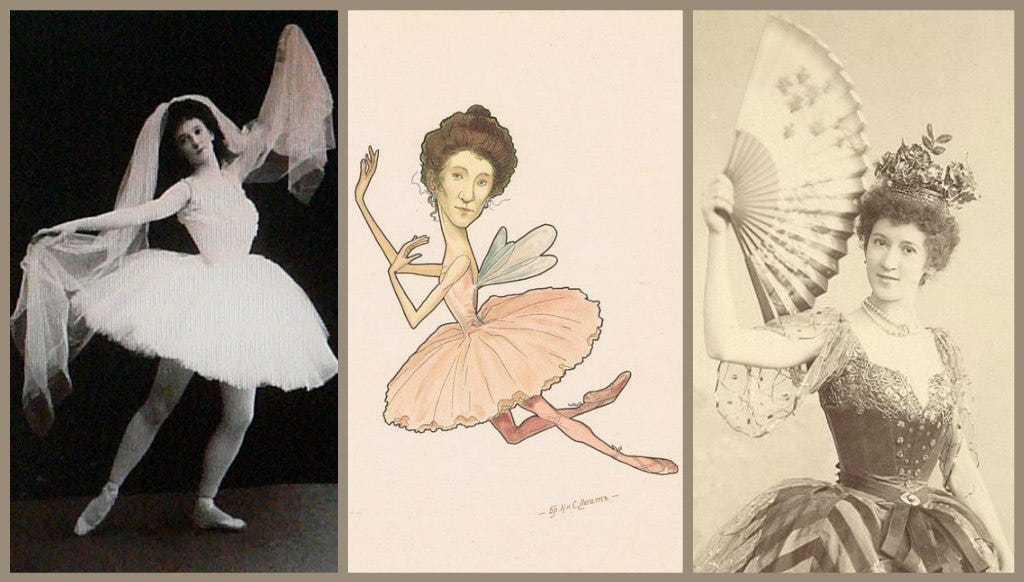
(All pre-1918 Dates are given Old Style)
Introduction
The names of Matilda Kschessinskaya and Olga Preobrazhenskaya resonate through the times, unmissable when you turn the pages of ballet history books or browse online. However, these ballerinas have a nigh forgotten peer: Varvara Rikhlyakova. She was a prodigious talent blessed with pretty, blond looks, an admirable jump and noticed by Petipa. So why did it not happen for her? What was her connection to Isadora Duncan? This article will go into that and the setbacks she suffered, such as tuberculosis, a lack of benefactors and ... Kschessinskaya. For much of the personal information on Varvara Rikhlyakova we owe her grandson, Vadim Rikhlyakov (1941-2024).
The Theatre School
Varvara Trofimovna was born on 4 December 1871, the fourth child of Mariinsky employees. Her father was a music copyist who eventually made orchestra member, and her mother sang in the chorus. Nine years on, Trofim Rikhlyakov arranged an audition for his daughter for the famous Imperial Theatre School to let her study ballet. She was accepted, and her younger siblings Natalia and Georgy followed in her footsteps, going from ‘junior associates’ to corps-de-ballet members.
Rikhlyakova quickly became the childhood crush of Alexander Gorsky who, later in his career as chief choreographer of the Bolshoi, liked to have danseuses model for him, a bit à la 20th-century fashion designers. Already multi-talented as a child, Alexander Alexeyevich crafted Rikhlyakova two fans (a craft he had picked up from his father), sewing and designing them himself. In 21st century ballet, a fan is mostly an object overzealously waved about by Kitri, and predictably, we see Gorsky’s gifts as ‘just presents,’ but in bygone eras one knew fans to be instruments of subtle courtship language – and intended as such by the romantically inclined and dreamy Gorsky.
In 1884, Rikhlyakova switched to boarding. There are early records of her theatre life found in the diaries of her classmate Kschessinskaya. Via these we can, as it were, let a camera zoom in on three girls, Rikhlyakova, Kschessinskaya and Nadezhda Vishnevskaya doing girly things in a studio while awaiting the teacher Nicolai Volkov, who was to conduct a rehearsal of Zoraya. Just over 50 and recently retired from dancing, Nicolai Ivanovich had lost nothing of his leanness and very dark hair – presumably using his stage presence to awe his charges.
The celebrated Virginia Zucchi had arrived at the Imperial Ballet in 1886. When she danced in Petipa’s l’Ordre du Roi, Rikhlyakova participated in the Golden Bud Dance from the Peacock Divertissement. There are no greater ballerina fans than young dance students. Once finished, Rikhlyakova and Kschessinskaya, hurried back from the dressing room to the wings to watch Zucchi and Enrico Cecchètti perform the pas de deux (Le Pêcheur et la Perle). Perhaps to their disappointment, they found Zucchi to be utterly human, deadly afraid to go on stage, crossing herself incessantly and fist bumping them for good luck.1
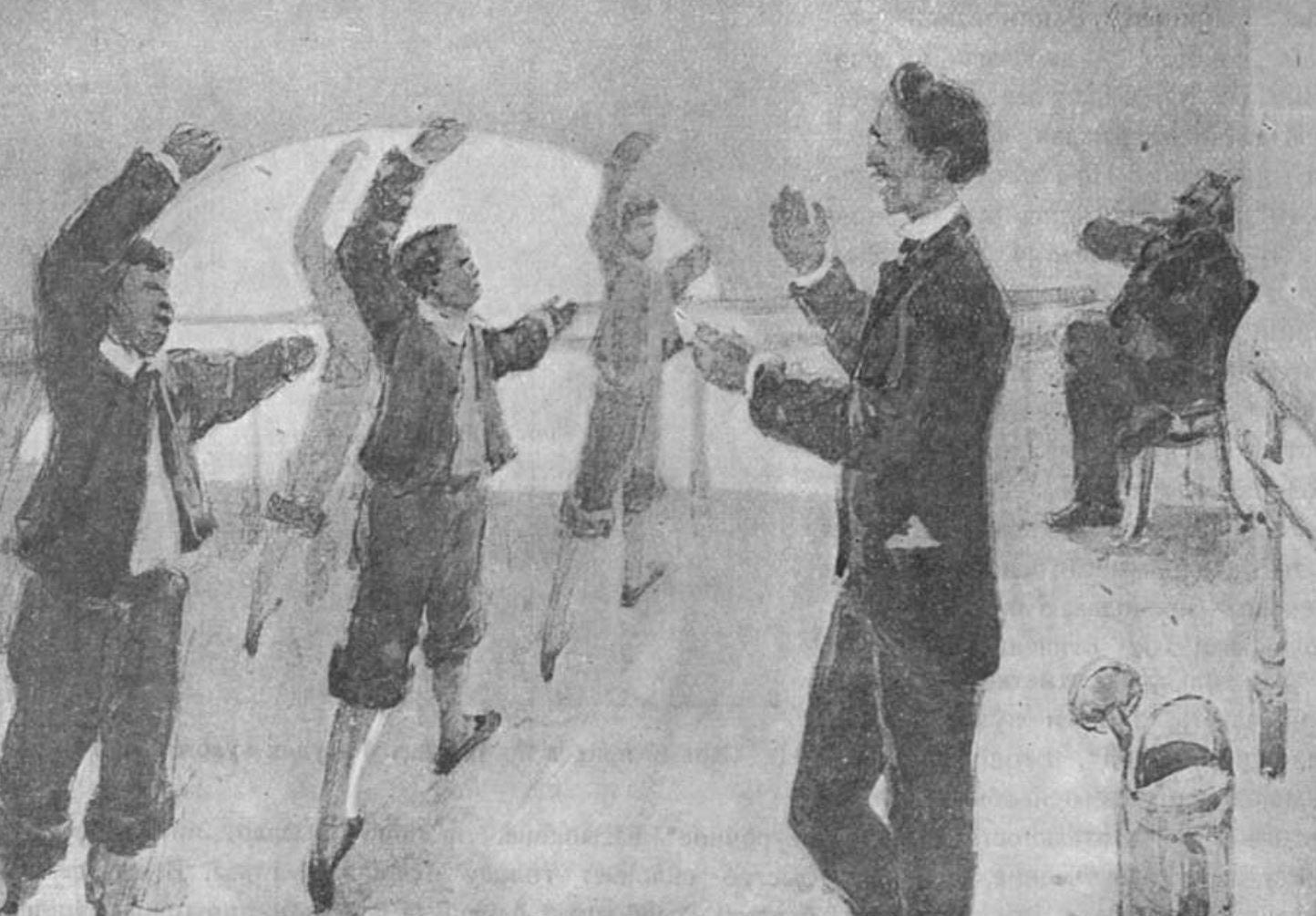
Matilda’s father, the renowned character dancer Felix Kschessinsky, announced she would dance the Pas des Guirlandes from The Wilful Wife on his benefit performance with Rikhlyakova. They were to be rehearsed by Christian Johanson, the Swedish Master of the French School, the house style of the Peterburgian ballet. Plausibly unaware of, or rightfully ignoring his daughter’s petty rivalries, Felix Ivanovich presented Rikhlyakova with a signed photograph and a box of chocolates on the day. This appeared to have been a common practice (Zucchi had distributed the same present to all on her benefit), so Kschessinskaya’s diarising it illustrates how it rubbed her the wrong way. She craved acclaim: ‘… [the ballerina Varvara] Nikitina and Zinaida Frolova praised me to heaven and back, saying that I danced better than Rikhlyakova …’
Treasuring such a compliment from established dancers is only natural, but Rikhlyakova’s prowess proved to be a growing concern of Kschessinskaya, who described Rikhlyakova diplomatically as ‘a classical dancer with a virtuoso technique’ in her memoirs. Running up to the student performance of 13 April 1888, Rikhlyakova features as the classmate she rehearses, laughs and bickers with. They danced in the Pas des Nations from Coralli’s La Péri, and there was a duet from Perrot’s Gazelda, two ballets from the past. Both Rikhlyakova and Kschessinskaya knew they were considered ballerina material, something the critic Alexander Plescheyev had also acknowledged.
When Les Caprices du Papillon premiered, Rikhlyakova was in Nikitina’s butterfly-retinue. It was the season of her graduation. Presumably, she was benched by sickness when Sleeping Beauty premiered (1890), for she did not participate in the Danse des Demoiselles d’ Honneur et des Pages (Aurora’s Friends) with her (promising) classmates. Arguably the least technical of the girls, Maria Skorsiuk, danced in her stead.2 Shortly afterwards, Rikhlyakova made her mark during conductor Alexei Papkov’s farewell benefit. Plescheyev opined: ‘… The debut of three young daughters of Terpsichore’s large family, Kschessinskaya 2, Skorsiuk and Rikhlyakova […] formed the benefit’s highlight. The variation of Rikhlyakova, a slender dancer […] came out praiseworthy; she was precise and effortless. She also danced a pas de deux by Cecchètti to a considerable success ...’
The graduation ceremony took place on 27 May. Rikhlyakova could be pleased with herself, her marks were stellar, outdoing Kschessinskaya’s. Both girls entered the company in the coryphée rank on a salary of 800 rubles. Petersburg Leaflet spread the rumour that Petipa’s The Two Stars (1870) was to be revived for them. That did not materialise, but it says again something about their potential.
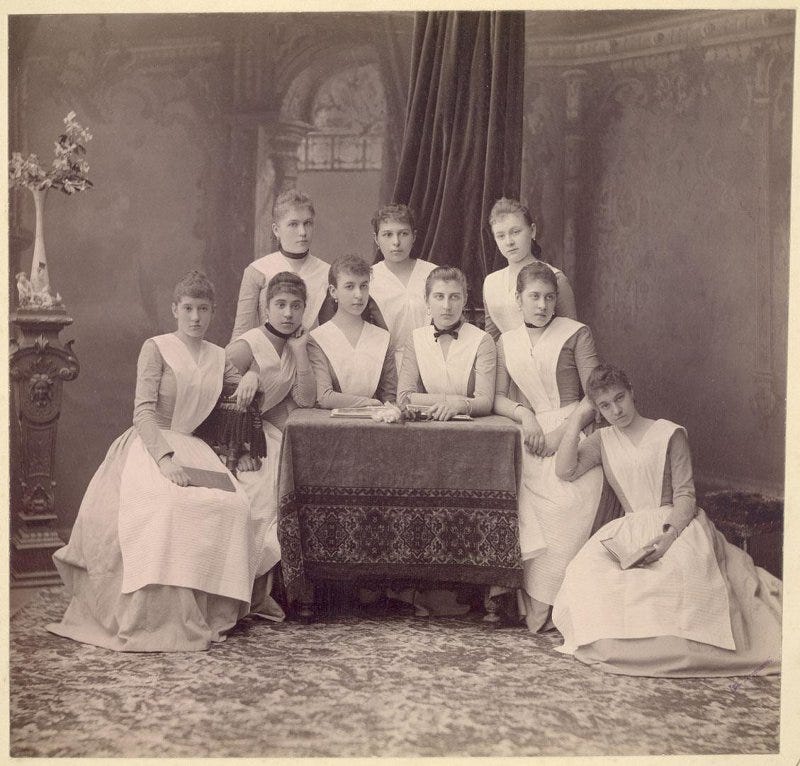
Early Mariinsky Years
The Krasnoe Selo season was a yearly summer season with drama, opera and ballet. The dance section (‘act,’ as Russia calls it) was curated by Lev Ivanov. The venue: a stylish wooden theatre where the stalls were informal benches. That year, Ivanov included a pas de cinq from the long-gone Two Thieves and a quartet from Carnaval à Venise, featuring Rikhlyakova and other fresh graduates partnered by the upcoming Nicolai Legat. The first of Petipa’s premieres Rikhlyakova participated in professionally was Nenuphar. The story dealt with a fatally beautiful waterlily spirit. Rikhlyakova was acknowledged for her work as a Forget-Me-Not (Petersburg Gazette) but on 16 December, the management singled her out to do an inserted pas de deux in Ivanov’s The Tulip of Haarlem, with Georgy Kyaksht.
Immensely pleased with the success of Sleeping Beauty, Vsevolozhsky and Petipa looked for another story to accommodate Carlotta Brianza ‘perfect technique’ (Plescheyev) and dark-haired beauty. They pulled Ludwig Minkus out of retirement for Kalkabrino,3 a horror story set in the Provençe with a book by Modest Tchaikovsky. Brianza delivered a good girl-bad girl job à la Swan Lake. Anti-hero Kalkabrino, Pavel Gerdt, is dragged to hell by the devilish Draginiatza, Brianza, but not before the Grande Farandole Fantastique is danced. The number was made up of She-Demons, led by Rikhlyakova and Kschessinskaya. It elicited the following remark from Konstantin Skalkovsky: ‘… […] praiseworthy is Mr Petipa’s wish to advance the ballet’s young talents. Miss Rikhlyakova […] and Kschessinskaya demonstrably justified this object …’
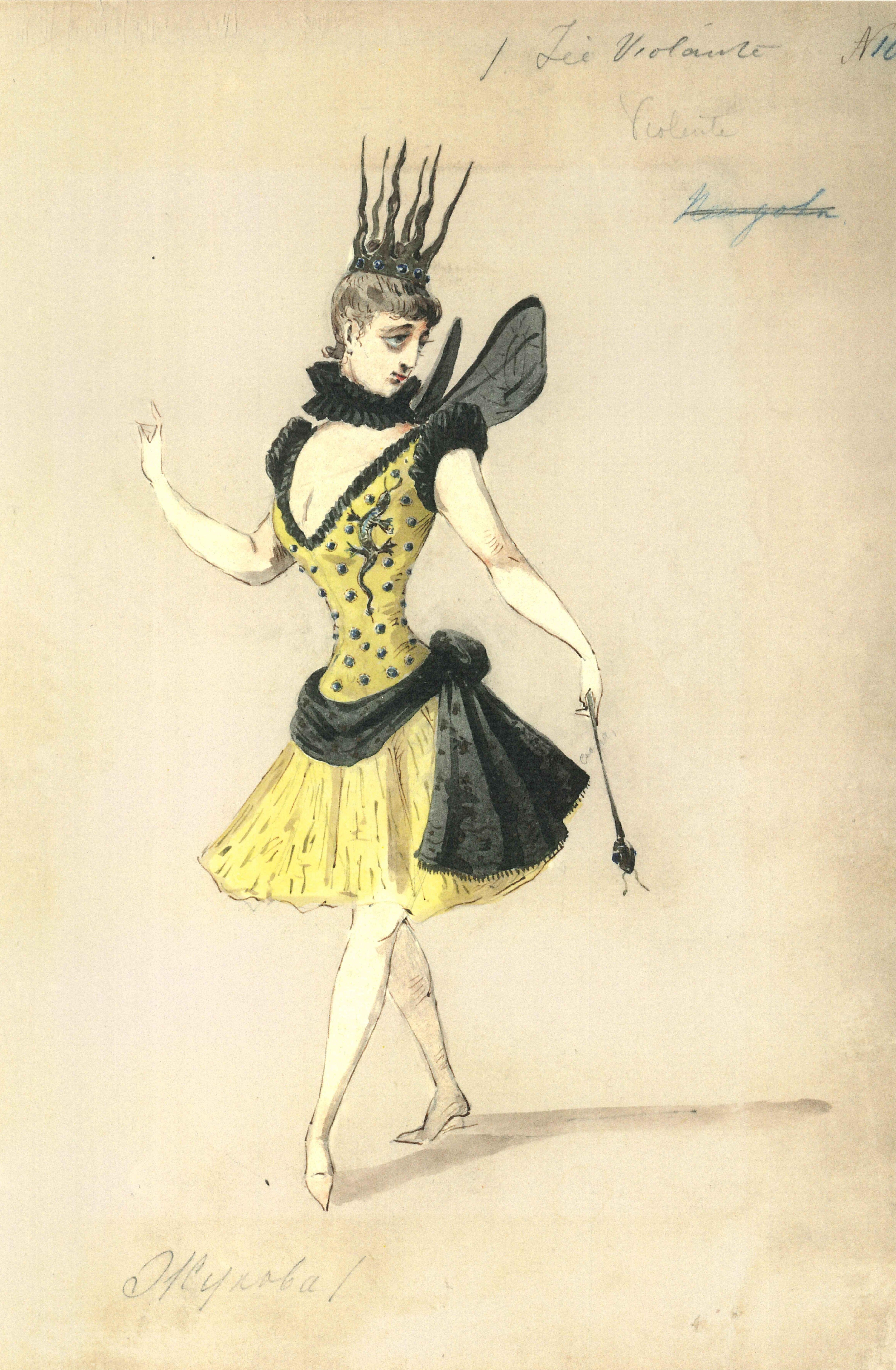
1890/91 was Sleeping Beauty’s 2nd season, and the ballet was billed 21 times. Rikhlyakova started to dance Fairy Violante, eight times in all. She also did a variety of other roles; Fairies Fleur-de-Farine and Silver and the White Cat. After Lent, Vera Zhukova retired and Rikhlyakova inherited Violante. She would dance that fiercest of Prologue Fairies throughout her career. Krasnoe Selo brought a pas de deux in the light-hearted Boatman’s Festival, which Nicolai Legat remembered to have danced with Rikhlyakova (an insertion from l’Ordre du Roi). The rep list in his memoirs is not completely reliable, and Roland John Wiley has it that the premiere was with Kschessinskaya. Then again, Rikhlyakova may have made a more lasting impression on Nicolai Gustavovich as second cast.
Petipa’s two grand, antiquity-themed ballets were presented next: the last complete performances of La Vestale, and a significant revival of Le Roi Candaule. Candaule teemed with anti-heroes: the unlawful King Candaule, his Lady Macbeth-like queen, the opportunistic Gyges and the scheming seer Pythia. The ballet’s opening scene sort of starts where Daphnis and Chloe ends, a happy pastoral gathering of innocent peasant and shepherds. The character Gyges (Alexander Oblakov), still unspoilt, is seen romping with his betrothed, Clythia, danced by Rikhlyakova. Analogue to Gyges’s rise, Clythia is no longer seen during the course of the ballet. This gave Petipa room to let Rikhlyakova dance in the Graces too; a pas de trois in the manner of Pharaoh’s Daughter’s Almées, wrapped in a ballabile (the Grand Pas Lydien) together with Kschessinskaya and Maria Anderson. Plescheyev gave some insight on what Rikhlyakova danced: ‘… each ‘Grace’ had something outstanding: Miss Rikhlyakova very cleanly executed four entrechats six in a row …’
Another dancer with commendable elevation was the arrived Nikitina. To highlight that gift, Petipa staged La Sylphide for her, doing so to the score by Schneitzhoeffer, then standard. A kilted Rikhlyakova danced in the pas de quatre of Effie’s friends, with Kschessinskaya, Preobrazhenskaya and Legat. According to concept cast lists, Petipa planned for Rikhlyakova (and Kschessinskaya) to dance in Act II, but in the end, they failed to make the Grand Pas des Sylphides. Since the leading sylphides were performed by senior soloists, it looks like they were doubles. The 1892 season at Krasnoe Selo was another one where Rikhlyakova made her mark (Plescheyev).
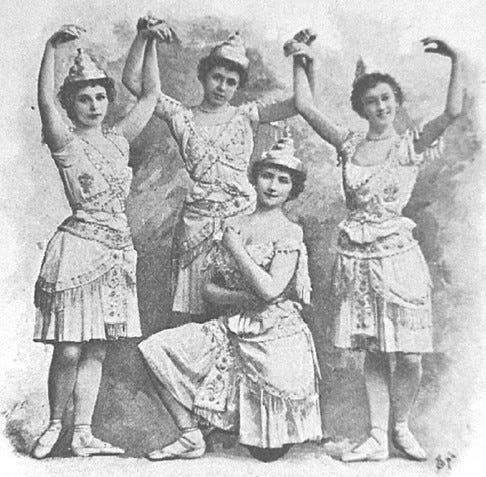
The autumn of 1892 brought the premiere of The Nutcracker. Rikhlyakova was a leader of the Grand Ballabile (also dubbed Golden Waltz, because of the Marigold-inspired costumes), as the Flower Waltz was called back then. She would move on to the Chinese Dance later. On the last show before the Mariinsky closed (2 May 1893), Paquita was programmed. To accommodate the graduating Vasily Tikhomirov, there was an inserted pas de deux with Rikhlyakova. Tikhomirov, Gerdt’s student, awaited a brilliant career awaited in Moscow.
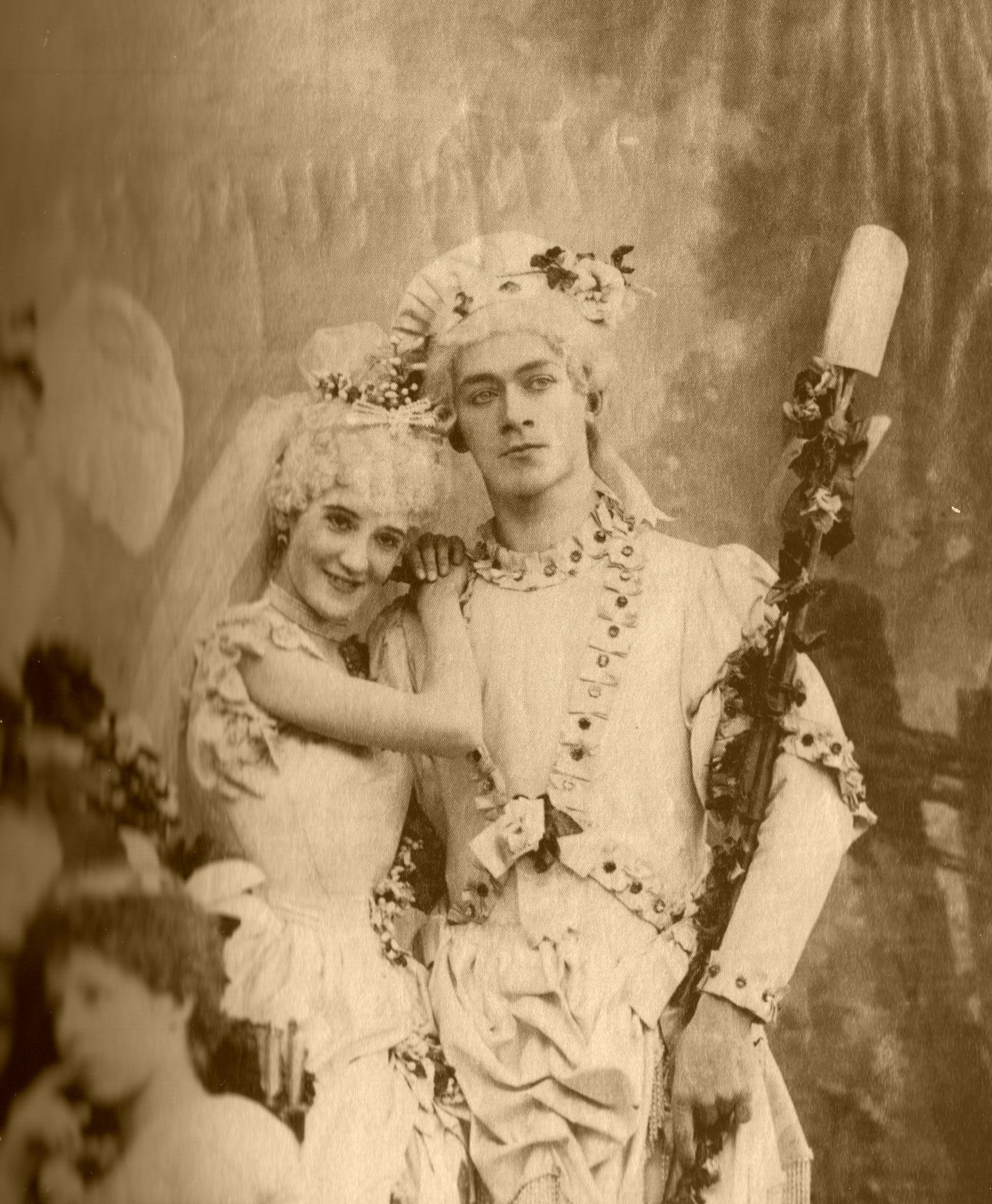
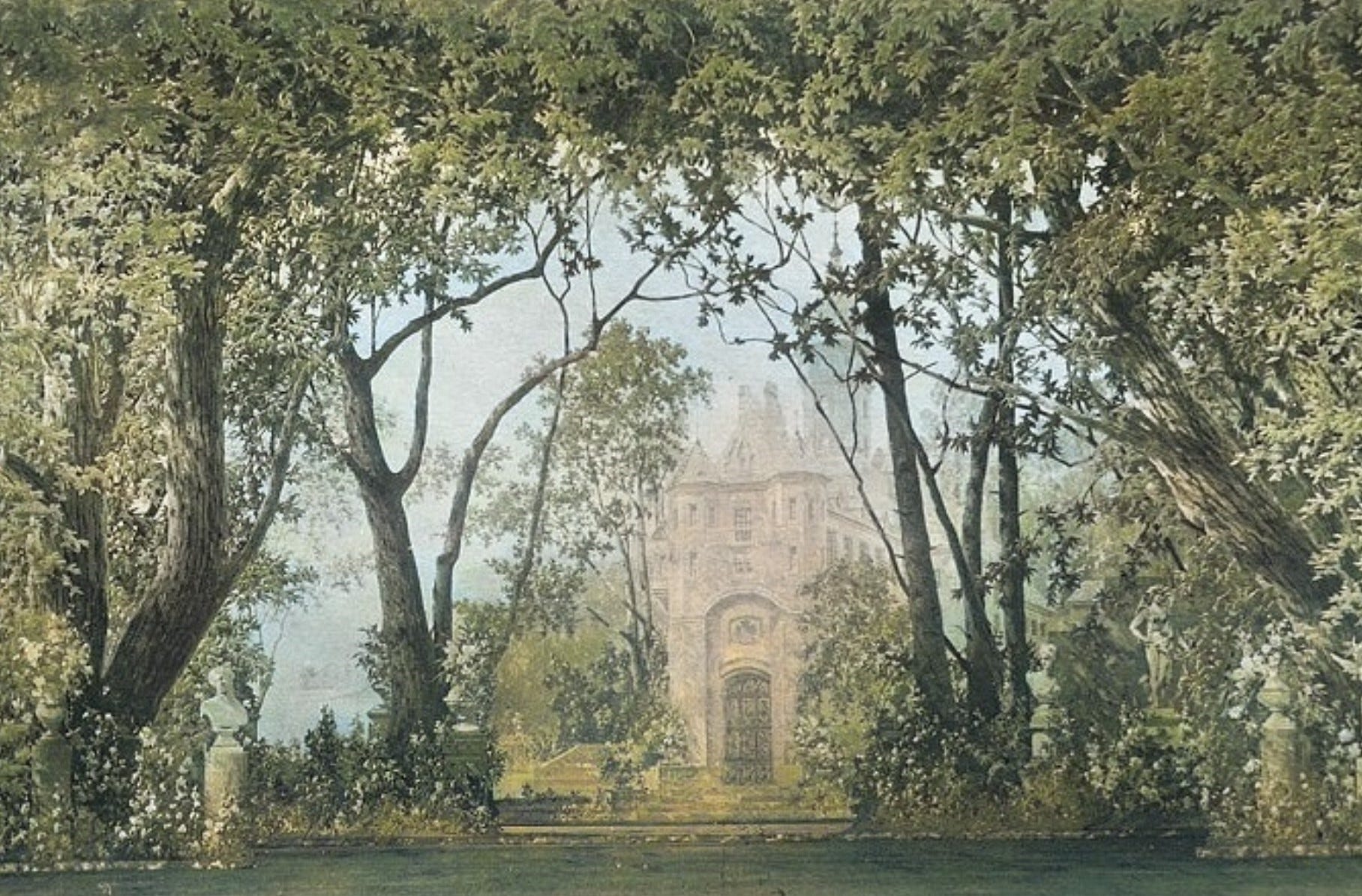
Ivanov was tasked with bringing back The Offerings of Cupid in the beginning of 1893/94. Something of an exquisite bagatelle, Petipa made it in 1886 for the tsarina’s Name Day, which premiered on Peterhof’s Olgin Island, that fairy-tale stage with an artificial lake as background. The characters very much resembled Meissen porcelain groups, objects Maria Fyodorovna loved to stuff her apartments with. Rikhlyakova was cast as Lisa, which required not ‘just’ dancing but acting as well. Lisa enters the stage when her beloved, Hylas, places a wreath on the foot of Cupid’s pedestal. She jealously thinks he does that to enlist the god’s help to pursue other girls, but is soothed by Hylas’s promise of eternal love. After the characters Chloe and Paris go through a variation on this routine, there’s general dances to thank Venus (for pacifying the wilful Cupid). The Offerings of Cupid held repertoire for several seasons. Unfortunately, Rikhlyakova’s tuberculosis played up, and she had to take a leave from March to September.
Then Pierina Legnani arrived. The Italian ballerina was to set a technical standard and amazed St Petersburg with 32 fouetté turns, first displayed in the Ivanov/Cecchètti Cinderella. Naturally, the company was in uproar, having seen the feat at the rehearsals. Cinderella was a grand ballet, and Rikhlyakova featured twice: she led the Pas des Étincelles in Act I together with Preobrazhenskaya, and appeared as Air in the Danse des Quatre Elements. She wore a pale blue costume, sporting butterfly wings wherever she could humanly support them, in her tiara, on her tarlatan, back and as a prop. ‘… our […] coryphées danced excellently, Miss Rikhlyakova [should be named] …’ (Birzhevye Vedomosti).
The directorate had been looking for a way to prolong the musical path of Sleeping Beauty, but after The Nutcracker Tchaikovsky had prior commitments, and the old Moscow ballet Swan Lake came up in talks. While the company was rehearsing Cinderella, the composer suddenly died (this all played out in less than a year). During Tchaikovsky’s memorial concert, the first Lake Scene was piloted. Rikhlyakova was among the ‘Little Swans’ (an epithet not seen in the imperial programme books and beyond) at the time lumped with the ‘Big Swans’ as variations of the Grand Pas des Cygnes, with her sister Natalia in a moment of glory as Big Swan. Before this, Rikhlyakova danced in another quartet, in Katarina. Her waltz was praised by Plescheyev – who could be considered a fan by then. A small highlight happened when Rikhlyakova and Kyaksht tackled the difficult Pas de Voîle from l’ Ordre du Roi, inserted in Paquita. It allowed her to display her phenomenal ballon, and Kyaksht’s equally phenomenal pirouettes. In the Krasnoe Selo season, Rikhlyakova performed in a fragment of the rarely billed La Péri.
The company opened 1894/95 in the Alexandrinsky and Mikhailovsky Theatres, because the Mariinsky’s renovation overrun. The Petersburg Gazette mentioned Rikhlyakova for an inserted pas de deux she danced with Nicolai Legat; commending her work in the adagio and the double coda, so graced by her elevation. In the first wintery days of 1895, the company wrote history with Swan Lake. Now presented as a full-length, it became the model for virtually every future version. An abandoned draft has Rikhlyakova listed for a variation somewhere in the first scene; a separate item, meant to precede Petipa’s intended pas de deux or pas de quatre (in the end, of course, a pas de trois). As soon as the merry guests had assembled in front of the palace garden, Rikhlyakova was on: together with Preobrazhenskaya and Kyaksht she formed the first ever cast of the pas de trois. Her solo (the second female one), consisted of filigree pointe work, little hops, bourrées, tombés and ronde jambe; a ‘point happy’ variation as Robert Greskovic put it.
The Petersburg Gazette assessed the trio as follows: ‘…This pas is technically hard, largely on pointe and with double turns, and magnificently performed …’ Novoe Obschestva: ‘… Of the performers, Miss Rikhlyakova stood out for her ethereality and her rather fine technique. This young dancer should work on the positions of her body and arms: the torso is at times is stooped over, and the arms not always sufficiently rounded …’ Journal de Saint-Petersbourg ignored Rikhlyakova: ‘… the pas de trois in which Miss Preobrazhenskaya and Mr Kyaksht distinguish themselves ...’ And Plescheyev was ambiguous towards Rikhlyakova: ‘… Mme Preobrazhenskaya, Rikhlyakova I and M Kyaksht execute graceful dances, of which many are very good [sic] …’ before filibustering a complete paragraph on the achievements of Preobrazhenskaya and her variation.
There is a possible explanation for Rikhlyakova’s partly admiration. Conjecturing: did she substitute for Kschessinskaya? This because her more prominent peer did not feature in Swan Lake at all, while Rikhlyakova was already cast in the Swan Scene. Matilda Felixovna was no ballerina yet, but trying to forego non-leading roles at this point in her career: she had already quit doing her stepsister in Cinderella.4 Withdrawing from the pas de trois would have been the next step. The required steely pointe work was Kschessinskaya’s specialism, and the variation is one prone to be sped up, something Kschessinskaya excelled in, even at a later age (Alexandra Danilova). Rikhlyakova’s forte was her jump, yet Petipa had assigned the jumping part to Preobrazhenskaya. So, did Rikhlyakova join the rehearsals when it was too late to bend the trio’s structure? Mastering it at short notice may have gone at the expense of her placement, hence her reviews. The hasty costume change Rikhlyakova now had (from pas de trois to swan) is another indication, for that was unusual back then. Novoe Obschestva treated her better as ‘Little Swan:’ ‘… The variation of Miss Rikhlyakova, [Evgenia] Voronova and others is originally composed ...’
Not so Plescheyev, whose admiration for Rikhlyakova diminished here: ‘… Apart from the ballerina, Mmes [Evgenia] Voronova, [Vera] Ivanova, [Anna] Noskova and Rikhlyakova and others distinguished themselves. As I see it, the most gifted here are […] Ivanova and Noskova. Rikhlyakova surpasses them technically and is generally the more skilled artist but does not similarly impress: her talent is quite run-off-the-mill – you get spot-on, light and effortless dancing, but without appeal. We have had an array of such employable, trustworthy yet bland dancers preceding her ...’
Question is: did Plescheyev find all that lacking from the Little Swans, whose job is to move mechanically precise – read with the antithesis of personal artistry - or did he lump this together with his critique for Rikhlyakova’s pas de trois? For, if Rikhlyakova was, as a swan, busy standing out from the group expression-wise, it would have disturbed the homogeneity. Anyhow, observations such as Plescheyev’s laid the base for Rikhlyakova’s Soviet perception.
Middle Mariinsky Years
1895/96 did not treat the patrons to a big premiere, but there was the major revival of The Hump-backed Horse, a showcase of dances with a sizeable ballerina role for Legnani. Rikhlyakova danced in the quartet of Frescoes, a rare extant number of Pugni’s ballet (finding favour on Plescheyev’s sheet) and in the character number Ural Cossacks. With its grand saut de basques, it needed good elevation (it was later successfully danced by Anna Pavlova, a review of whom reveals this key step). Rikhlyakova replaced Anna Johanson twice as the Nereid Queen, the second ballerina role. She was first seen on the enchanted island (Act II, scene 2) where the Tsar-Maiden (Legnani) lands, dancing in the Pas des Nereids, and reappears as Water Queen in the Grand Pas and Bacchanal in the Underwater Scene (Act III). Rikhlyakova would dance the role often.
A big event was the last-ever coronation of a tsar, and the Mariinsky troupe left for Moscow to be part of the official festivities. Petipa’s sumptuous The Pearl premiered on 17 May in the Bolshoi Theatre, with Rikhlyakova dancing in a sextet of White Pearls. She was promoted to the rank we now would call second soloist.
The next season brought two huge full-length ballets: Mlada and the premiere of Petipa’s Bluebeard. Mlada, a Slavic story, had an interesting genesis; it was first thought up as a multi-theatrical pet project of Stepan Gedeonov, the director at the time, in 1870. Involved were the nationally inclined composers Balakirev, Borodin, Cui, Mussorgsky, Rimsky-Korsakov, ‘The Mighty Handful,’ with the danced parts by Minkus (1872). When that came to naught, Minkus disentangled his music for Petipa’s ballet version in 1879. Rimsky returned to the idea in 1892, recreating Mlada as an opera-ballet and now Petipa revived his ballet for Kschessinskaya. Rikhlyakova was not in a good place during the rehearsals. Fighting tuberculosis and a stagnating progress made her rude and neglectful, and when she skipped a rehearsal (presumably of the Shades) she was kicked out of the ballet altogether.
Petipa celebrated 50 years in Russia with a gift to his adopted country: a new take on Bluebeard.5 The story of the femicidal brute was cleverly woven into a plethora of dance numbers accommodating both company and school. Rikhlyakova danced in a pas de quatre, Les Concours de Prix de la Danse, together with Ivanova, Noskova and Vera Mosolova. Bluebeard (Gerdt) himself handed out prizes, as did Plescheyev - press-wise - for Rikhlyakova (and Noskova). Rikhlyakova and her colleagues celebrated Petipa’s jubilee on 20 December in the prestigious restaurant Cubat.
Similar to the previous season, 1897/98 had two big novelties, this time both a premiere: The Mikado’s Daughter and Raymonda. Much surprise has been uttered about the choice to do the Japanese féerie, which stretched the limits of the company’s signature, but there it was. Mikado’s Daughter outdid everything in terms of, er, everything: dances, dancers, extras, costumes, number of props and stagecraft. Neither the company nor the critics appeared to know what to do with it. Rikhlyakova danced three numbers, Les Fantômes d’Orient and Danse Lent (Act II) and ‘Dance under the Parasol’ (Act III) with Nicolai Legat.
In the first week of 1898, dance history was made with Petipa’s Raymonda, to Glazunov’s sublime score. Rikhlyakova’s smooth classical technique ensured her casting in various pas, and that is how she was distributed in Raymonda; in La Gloire, wherein the titular heroine dreams of being united with her crusading knight. Rikhlyakova led a cast of celestial beings together with Ekaterina Geltser. Her variation was a particularly peaceful solo accompanied by the celesta. Petipa made use of her generous batterie. Rikhlyakova also danced in the celebrated Grand Pas Classique Hongrois.
However, in Raymonda’s 2nd season, she substituted for Preobrazhenskaya as Henrietta, a role with an identity and much acting. Together with Clémènce, Henrietta surrounds Raymonda with warmth, accompanying the young chatelaine’s actions in Act I, and engaging in a meaty pas d’action in Act II. Henrietta’s allegro variation suited Rikhlyakova’s artistic temperament and she went on to dance the role on a regular base. Shortly after Raymonda’s premiere, Rikhlyakova got sick again and thence welcomed back warmly by the public during Felix Kschessinsky’s benefit (8 Feb).6 It was something the elder Kschessinsky probably smiled about, but Matilda Felixovna, who could landscape her Strelna garden with the flower arrangements schlepped on stage on her behalf (Plescheyev), surely perceived it as limelight-stealing.
After Lent, Mikado’s Daughter reached its 8th performance. From then on, only Act I came to be given. Kschessinskaya ceased to perform it, and this prompted the management to try Rikhlyakova out in the ballerina part, Hotaru-hime. The remaining act contained an elaborate grand pas.7 Rikhlyakova was nervous, aware that this was a test for ballerina-hood. Plescheyev noted how she did rather well in the adagio, in the sturdy hands of Gerdt, but to mind springs the scoffing remark of her colleague Vaganova, uttered years later: “Every fool can look good when partnered, it is in the variation your merit will show.” And that’s what happened to the poor Rikhlyakova, who dropped the ball technically there. Plescheyev compared her negatively with Kschessinskaya, who tossed off every technical morceau whistling, as it were. The observation was unfair, for Kschessinskaya had years of practise in leading roles under her belt by then. Rikhlyakova scored with her audience nonetheless, and received a basket of flowers. Conform company policy, she was not taken off Hotaru-hime. Sadly, except for Naiad and Fisherman, also as a single act, ballerina parts would not go further for Varvara Trofimovna. She closed the season with appearances in Sleeping Beauty’s Bluebird Pas de Deux and Paquita.
Petipa had staged Le Corsaire often and did so once more in 1899, for Legnani. Rikhlyakova danced the Pas d’Esclaves with Nicolai Legat. All current derivations of Le Corsaire pair the role of Gulnara to the Pas d’Esclaves (Act I), but Medora originally encounters that character later on, in the Harem. On 26 September, Rikhlyakova danced the Peasant Pas de Deux in Giselle with Gorsky. Bezobrazov reported: ‘… they pulled off these classical steps with ease …’
The last month of the century belonged to Lev Ivanov: he celebrated his jubilee benefit on 5 December with a mixed programme. Three days on, stressful moments occurred on stage for Rikhlyakova. During Pharaoh’s Daughter, she and Klavdia Kulichevskaya needed to improvise when both Kschessinskaya and Preobrazhenskaya mysteriously failed to finish the grand pas d’action. On 18 December, there was a lavish party for Ivanov at Cubat, and Rikhlyakova was in attendance.
For 1900, Petipa prepared no less than three premieres: The Trials of Damis for Legnani’s benefit on the 23th Jan, followed by The Seasons (7 Feb) and Harlequinade (10 Feb). All these started out as court shows in the stylish Hermitage Theatre. ‘Damis,’ or Les Ruses d’ Amour, was a peculiarity in Petipa’s oeuvre, a Watteau-inspired piece that hardly touched on academic ballet technique. Rikhlyakova played a puppet. There were four doll duets, following one another in rapid succession, and she danced the second with Shiryaev. After their routine, the players were paid and left the stage. The Petersburg Gazette: ‘… Of all the dances […] only one number warranted loud applause of the public - the dances of the wandering troupe, with Miss Preobrazhenskaya, Petipa 3, Rikhlyakova and Obukhova dexterously imitating puppets on strings …’
The critic Nicolai Bezobrazov thought that The Seasons did not qualify as a true ballet and should be advertised as ‘allegorical scenes with dances.’ Unfortunately, it was not notated, so we cannot verify that for ourselves, but the libretto is indeed quite short. Spring sounds like a scene dansante, and Bezobrazov further chided that it had the stage ‘almost empty.’ Glazunov had the flute open with the strings, and one cannot miss his suggestion of a swallow, circling and looping: Rikhlyakova. She ‘hovered over’ and flitted between Preobrazhenskaya and Nicolai Legat as Rose and Zephyr. Needless to say, Petipa should have accommodated Rikhlyakova’s jump, yet the costume might not have helped there. Vsevolozhsky designed a fuchsia tarlatan enriched with birds, which looks uninviting to do a nice bit of streamlined elevation. The drawing has been subject of easy scorn, but if any designer today would cram a starkly coloured costume with eye-catching, sewn on birds, design awards would pile up. It bears no dancer’s name, and that conforms to the notion that Rikhlyakova was not considered for the Swallow from the outset: Petipa had her down for a variation in the Winter section. As if this triptych was not enough for 82-year-old Petipa, he produced Les Élèves de Dupré, in parts a reworking of l’Ordre du Roi. Rikhlyakova was among a rich cast of principals, dancing the part of Rose, a daughter of the Count de Montignac – Lev Ivanov.
Petipa’s final take on La Bayadere re-entered the repertoire on Gerdt’s benefit on the 3th Dec, never to leave the Mariinsky boards again. Rikhlyakova’s variation, that of the Second Shade, is among the best-preserved parts. After the grand and elegiac entrance of the corps de ballet, the Three Shades have their waltz, wherein Minkus’s music exquisitely combines optimism with melancholy. Today, audiences tend to crane trying to recognise the dancers as they appear diagonally upstage left, and on this revival premiere that should not have been different. Out of the wings came a handsome cast: Sedova, Rikhlyakova and Pavlova, in order of their variation. Poor Rikhlyakova. Soviet chroniclers finished typewriter ribbons trying to give Vaganova the best possible press of her complicated Petipa days and as a result, history associates the second shade with her, not Rikhlyakova: ‘To this day, it is known in the Leningrad Ballet as the ‘Vaganova variation’ (Natalia Roslavleva). Yet Varvara Trofimovna’s cabrioles en avant must have been as impressive or better, but then she never reformed a school.
Final Mariinsky Years
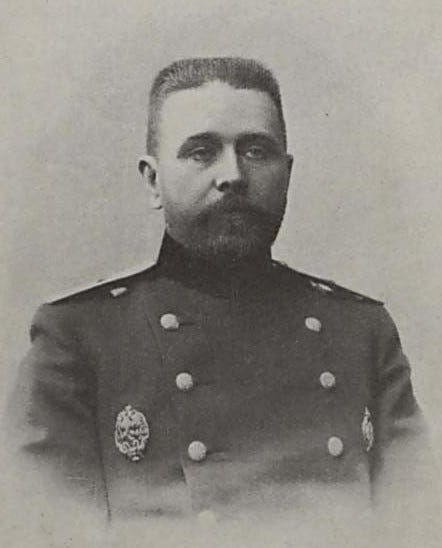
Rikhlyakova’s private life took a turn when she met Nicolai Tchigaev, a doctor and her senior by twelve years. Chances are that Tchigaev was recommended to Rikhlyakova, or that they simply became acquainted during intake. Aside from romantic interest, Tchigaev’s CV cannot exactly have worked against him: he taught at the university and was recognized for his medical research. To top that, the tubercular heir apparent, Georgy Alexandrovich, had been his patient, as was the poet Alexander Blok. Tchigaev was also the personal physician of Duke Alexander Oldenburg, whose father had composed the music used for the Pas d’Esclaves – which Rikhlyakova danced. It should have come up in their initial conversations.
This happened around the time Legnani’s contract was about to end. The Prima’s last benefit performance took place at the end of January 1901; a revival of Camargo, set by Ivanov with major contributions by Sergei Legat. Picture a baroque ball with a performance in a performance: Rikhlyakova danced a Wind Spirit in Legat’s Summer divertissement, with Camargo (Legnani) and Vestris (Legat) impersonating Summer and a Sylph. A month on, Rikhlyakova received a letter from Tchigaev. She read that he ‘was overcome by passion’ for her. Busy preparing and dancing Undine in The Naiad and the Fisherman, she hesitated, replying that she had no room for love. Rikhlyakova realised that she could not win this one; Tchigaev was married with children, in a time and age where divorce was not done.
On 15 April, Kschessinskaya succeeded Legnani as Camargo. As Wind Spirit, Rikhlyakova undoubtedly milked her airborne qualities; willingly looking for contrast with Kschessinskaya (and her meagre jump) or simply by letting herself go in the moment. This performance came with a bonus: the denouement of the showdown between Kschessinskaya and Director Volkonsky. The stake was his contribution to Camargo: a Catherine the Great dress for the Russian Dance, which Kschessinskaya had announced to distort by removing the farthingale (a hooped petticoat, which she thought would do nothing for her petite stature). Unquestionably, Rikhlyakova eagerly watched the outcome, either from the wings or back on stage. When Kschessinskaya was led out by Sergei Lukyanov, Varvara Trofimovna and her colleagues needed to suppress their gasp: Matilda Felixovna sported a slimmed down dress. She had disobeyed her director for all to see. If Rikhlyakova hoped this spelled the end of her one-time classmate’s antics, she would be in for a major disappointment: when Volkonsky pulled rank it cost him his head, but Kschessinskaya, damaged at first, bounced back with a vengeance.
During the autumn of 1901, Rikhlyakova danced three performances and was not seen again that season, which points to a severe episode of tuberculosis. Earlier misgivings aside, the relationship with Tchigaev began to bloom. Did a constant vicinity during treatment do the trick? About the same time, Rikhlyakova lost her zest for dancing, or so her grandson accorded. After all, she was a principal dancer without principal roles. Was her love for dancing replaced by a love for Tchigaev?
From 1901 to 1910, the year of her retirement, she was not seen that much on stage (discounting the reasonably productive 1903/04 season). She missed out on the Legat Brothers’ Fairy Doll, and neither was she cast in Petipa’s The Magic Mirror and the cancelled Romance of a Rosebud and Butterfly. ‘It dawned to her that she was not destined for stardom’ (Rikhlyakov). Petipa himself acknowledged that she lacked backing of influential patrons. Kschessinskaya had her ties to the Imperial House, Preobrazhenskaya had had Volkonsky’s brother to help further her career while Pavlova, that audience favourite, set herself up with critics like Valerian Svetlov. The new director, Vladimir Teliakovsky, stated that she was among the unfortunates who were given opportunities past their prime. Apart from this and her health, there were other contributing factors. When Varvara Trofimovna’s father died in 1902, her mother became blind, and it fell to her to look after her – not one of her numerous siblings – while juggling a career and a toddler (her niece). Since Anastasia Yakovlevna’s pension was a meagre 110 rubles, we must assume that she had left the Imperial Opera early on to look after her many children, of which Rikhlyakova presumably earned most money.
When Shiryaev revived The Naiad and the Fisherman, Rikhlyakova lost Undine to Pavlova and was relegated to the second ballerina role, the Naiad Queen. We have word that Undine and her queen were doing ok in the jump-department, but for Giselle’s Myrthe it’s definitely thumbs up there. On 6 October 1904, Rikhlyakova debuted in this role, and it is surely one that did her elevation justice. Before Giselle’s spirit appears (Act II), the Queen of the Wilis has something of a ballet suite for herself, wherein her grand jetés, entrelacés, entre-chat six, saut de basques and what not, represent dominance over her ghostly subjects.
Rikhlyakova had been cheated out of Myrthe fourfold initially. The first time was during Giselle’s 1899 revival, when Preobrazhenskaya landed it. Olga Iosifovna was many things but no Myrthe, lacking commanding presence, if not the rich elevation. Petipa must have realised this. Along Preobrazhenskaya’s Myrthe, the management had the excuse of Rikhlyakova doing Mikado’s Daughter in the same performances, but that was not the case with her successor: Lubov Petipa, who was machinated into the role by her father. A fine jumper too she, but it was a bit of an insult to Rikhlyakova, being passed over for a fresh graduate. When Lubov Mariusovna left the company, Myrthe went to other younger dancers, Julia Sedova and Lubov Egorova. The part finally came Rikhlyakova’s way when she was six years away from retirement, and as a substitute for Egorova at that. Already the next performance Myrthe was back with Egorova (Rikhlyakova returned to the role once, a few years on).
On 24 October 1904, Petipa diarised that he replaced the dancers Tchumakova, Makarova and Ofitserova ‘who were a disaster,’ in Paquita with Egorova, Vill - and Rikhlyakova. She returned to the languid variation that once belonged to the ballerina Maria Gorshenkova;8 Teliakovsky had diarised how good she was earlier that year. Tired, ill, and in love or not, this means Rikhlyakova could still give younger dancers a run for their money. Yet there is every chance that she could not care less by that time, for she was pregnant with Tchigaev’s love child. Predictably in anticipation of this, Tchigaev needed to time-manage two families and became a GP. A son, Nicolai Nicolaevich, born in March 1905, was given his mother’s surname.
In 1906, Rikhlyakova went through another down-fase. Her apartment was ransacked and all her cash was stolen (apparently, she preferred an old stocking to a bank) and the relationship with Tchigaev ended, due to ‘their complex characters and the situation’ (Rikhlyakov). The ‘situation’ being Rikhlyakova’s position as mistress. She had hoped for Tchigaev to make an honest woman of her. By the look of it, Tchigaev decided to give his career a boost again after the break-up; in December he was appointed senior resident at the Nicolaev Military Hospital. During this period, Rikhlyakova was rehearsing Nicolai Legat’s Puss in Boots. Her Court Lady was her first created role since The Seasons and would be the last. Her variation was positively noted. Alas, the first post-Petipa fairy-tale did not live beyond its second performance.
Children don’t come cheap, and now Rikhlyakova had to take care of two. She was haemorrhaging cash, needed to hire a nanny and move to a bigger apartment. She approached Teliakovsky, asking him to let her teach at the Theatre School. He agreed to it. Rikhlyakova first assisted Fokine, with whom she had danced the Bluebird Pas de Deux. His memoirs don’t offer a single word devoted to Varvara Trofimovna, so his impression of her cannot have been too smashing. As of the next season, she was appointed a full-time teacher for the lower classes. Svetlov bluntly advised her to stick to teaching from now on, rather than ‘running from her chicks to the footlights.’ Rikhlyakova did not do that, and so she remained one for Kschessinskaya’s target practice.
Rikhlyakova was not alone there. On 7 Feb 1907, Teliakovsky noted: ‘… Despite the fact that Kschessinskaya is no longer under contract but a guest artist, she constantly interferes, not only in ballets she performs […]. That way, she demanded that Trefilova be scratched from Sleeping Beauty and Sedova dance instead of Rikhlyakova in Hump-backed Horse…’
Kschessinskaya and Preobrazhenskaya, at daggers at least until the latter’s debut in La Fille mal Gardee (Jan 1906), had sort of made peace.9 Teliakovsky continued: ‘… Preobrazhenskaya, who always held a grudge against Kschessinskaya, is suddenly her friend and willing to dance behind her in supporting roles […] In Esmeralda, she wants to dance Trefilova’s role [Fleur-de-Lys, P.K.].10 At the same time, all of them call each other names …’ Kschessinskaya’s scheme succeeded for the performance in question, on the 18th Feb.
But Esmeralda was Kschessinskaya’s last beacon of appropriation and it went to her head – she did not stop at Fleur-de-Lys and had a go at Rikhlyakova again. After the said performance, Teliakovsky drew up the dreadful scene: ‘… The evening […] did not pass without incident. Kschessinskaya wanted to remove Rikhlyakova from her role [a Friend of Fleur-de-Lys, P.K.] and have Pavlova dance instead.11 Naturally she has no right to remove Rikhlyakova, and since she herself refused to give up her place, she was on. Kschessinskaya now arranged a claque, so when Rikhlyakova performed her variation, several people began to hiss ...’ Rikhlyakova must have been in a fluster, but stood her ground bravely, managing to turn the situation and gain the punters’ sympathy. ‘… Taking Rikhlyakova’s side, the public called her out to bow three times. How evil and intriguing is Kschessinskaya, stooping to play low tricks on a poor consumptive artist ...’ (Teliakovsky). The diva, awaiting her entrance for the Pas de Jalousie, must have eaten her tambourin in displeasure.
Kschessinskaya’s objectives were personal and petty; both she and Rikhlyakova were now in their mid-thirties, and the days Rikhlyakova had been able to threaten her were way behind them. Contrasting dramatically with this poor form was Rikhlyakova being the recipient of the St Stanislav gold medal, a prestigious award for outstanding artists.
Nevertheless, the next season Rikhlyakova did not dance in Esmeralda. Did she throw in the towel herself with a ‘fine, have it your way?’ It is worth remarking that Rikhlyakova was replaced by Lydia Kyaksht, a firm member of camp Kschessinskaya.12 But by 1908/09, Kyaksht had left, and Rikhlyakova returned to the role on 25 Jan 1909. Her last time. Since Esmeralda was a one-off that season, Teliakovsky likely put his foot down and not let his team put effort in teaching the part to another girl. At the end of 1909, Rikhlyakova danced her last Swallows in The Seasons. Svetlov could not help himself: ‘… in itself such a swift, graceful bird … and then, as if caught by hail, [there ‘flew’] the exhausted Mme Rikhlyakova …’
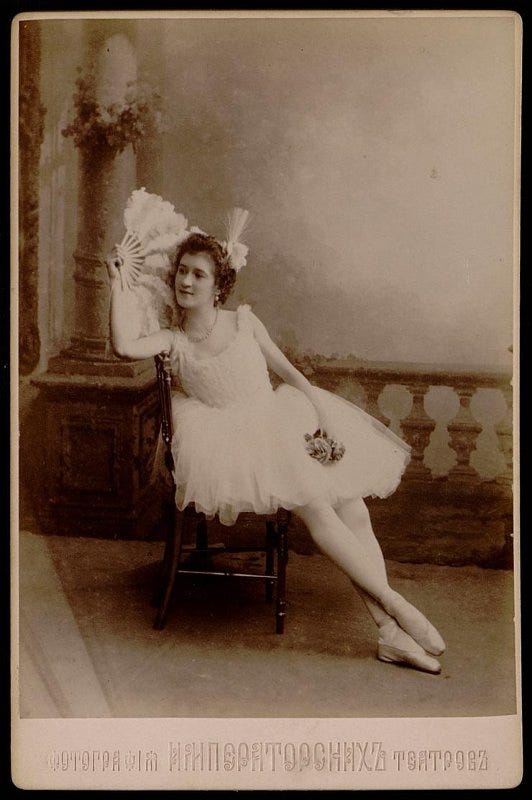
Rikhlyakova the teacher was remembered to be strict and dry (but good). She paid attention to a good posture, which she never ceased to show well herself. She had an eye for the arms too, whereas others merely looked if students clutched the barre. Sstricter in assessing mediocre students than her colleagues, Rikhlyakova clashed with the exam committee on occasion, refusing to meet them half-way. This annoyed Teliakovsky, but it shows that she was her own woman, not complying to the school inspector, Varvara Likhosherstova. Rikhlyakova’s teaching career does have a dust-gathered, yet remarkable moment in relation to dance history: her meeting with Isadora Duncan. Teliakovsky: ‘… Duncan spent several hours at the School - she was very interested in Rikhlyakova’s teaching and asked permission to come again. I allowed it and let the company dancers who wished to meet Duncan gather at the School, for she promised to demonstrate her dance system [bringing some of her own students, P.K.]’ In Duncan’s memoirs My Life, the artist painted a rather negative picture of the Theatre School, meaning she either was at her most diplomatic towards Teliakovsky and Rikhlyakova, or was asked by her publisher to lay on her reservations about ballet thick.
Teliakovsky’s last diary entry on Rikhlyakova covers her ‘constant clashes’ with Likhosherstova: ‘… They are troublesome women, the pair of them, but we need them both, for Likhosherstova is a good inspector, and Rikhlyakova is a good teacher. Likhosherstova complained to me today about Rikhlyakova. She continuously reproaches her for having her illegitimate daughter [sic] Maria Ilyinichna in the School,13 alluding to her upon discovering head lice in her students. All these squabbles are such a bore to me ...’ Apparently, Likhosherstova knew these head lice to be of a particular breed, fussily in need of ‘illegitimate heads’ to spread from.
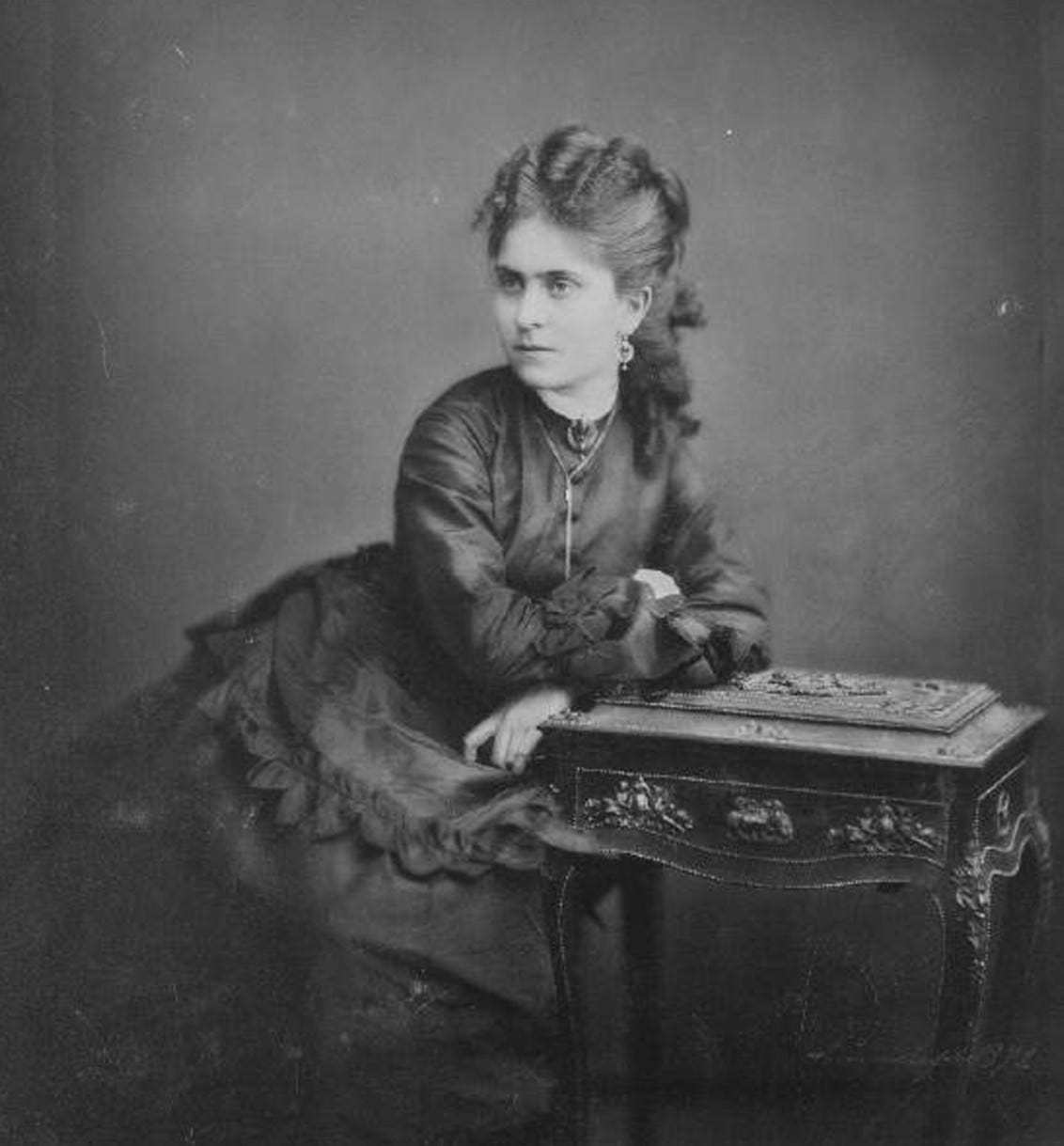
Retirement
Rikhlyakova was awarded a second gold medal (on the ribbon of St Alexander), mere months before reaching her official date of retirement (1 Jun 1910), something of a Lifetime Achievement Award. She received a pension of 1500 rubles along her teaching fee. Tchigaev’s added financial support allowed for a fairly comfortable life. Rikhlyakova travelled with her son Nicolai, then five, to Staraya Russia, known for its balneological mineral waters resort, to fight her uphill tuberculosis battle. There she heard the news of Petipa’s death. She should have mourned him.
When the First World War broke out, Russia’s deterioration took final form, a figurative landslide of 1/6th of the globe, ending in revolution and civil war. Little Nicolai Nicolaevich was accepted at the Theatre School in the midst of the turmoil. The revolution spelled doom for most artists, for the Bolsheviks terminated all pensions paid to former artists. Rikhlyakova was no exception, and she also lost her Theatre School appointment. Weakened, she ended up in hospital.
In this grim climate, private-school ballet classes were the last thing on people’s minds and Rikhlyakova, once discharged, had to resort to work in a grocery shop. When there was no longer food to sell, she landed a job in a community centre. In the winter of 1918/19, Rikhlyakova needed surgery. She was told it could be fatal. She left the hospital to settle her affairs - and learned that Tchigaev had died of typhus. Rikhlyakova arranged for her teenaged son to live with her adopted daughter (in 1918, the school had stopped offering housing) plausibly expecting the worst - her worries cannot have helped her condition. Rikhlyakova underwent the surgery, but was not destined to leave the hospital again. She died on 8 May 1919, three months after her ex. Varvara Trofimovna Rikhlyakova was buried in the Mitrofanevsky Cemetery, which shortly features in Dostoevsky’s Crime and Punishment. The site no longer exists, and the church was destroyed in 1927. It is tempting to draw an analogy here with Rikhlyakova, whose name no longer rings a bell, not even by those versed in ballet history.
Maria Rikhlyakova’s group of graduates was the first to enter the company after the revolution. Going by available cast lists, she was no high-flyer and made redundant in 1928 due to staff reductions. Nicolai entered the scene in 1923, eventually becoming a régisseur for the Kirov Ballet.
Upon Legnani’s departure, Kschessinskaya had ruled alone as the Mariinsky’s Prima Ballerina, officially as guest.14 With Preobrazhenskaya generally dancing a different repertoire, there were three dancers by whom she felt threatened: Moscow’s Lubov Roslavleva, whose Petersburg performances she thwarted and prevented, Anna Pavlova, for whom Teliakovsky broke her monopoly on La Bayadere and Pharaoh’s Daughter,15 and Rikhlyakova, whose technical talent and elevation had been a concern to her from the day she received top marks. Her own repertoire had hardly made demands on her jump, and her jetés en tournant of her debut, Kalkabrino, found favour because of their dynamic and verve, not their height and she knew it. ‘… Miss Kschessinskaya 2 showed herself exclusively terre-à-terre, her elevation remains a big question …’ (Novoe Obschestva, 1892). What perhaps bugged Kschessinskaya most, is that Rikhlyakova held a mirror up to her: what would have happened without ‘Nicky’s kisses,’ read: sans imperial protection at the highest level? If given the chance, would Varvara Trofimovna have developed enough interpretative skills to supersede her? Here is a slice of sensationalist thinking: Roslavleva died at 30, Pavlova at 50, and Rikhlyakova at 47. Kschessinskaya died in her 100th year. As if she had sucked up the life force of her rivals.
Conclusion
The name of Varvara Rikhlyakova is forever linked to Petipa’s last golden years. Alas, she was, as mentioned, a principal dancer who never moved into titular roles bar one-act programming. Yet when all is said and done, her health prevails as the salient reason for that – not Kschessinskaya’s machinations, shameful as they were. Rikhlyakova’s tuberculosis made her not overly reliable, and a management’s preferred quality in a dancer is just that: reliability, that unglamorous side of the profession audiences miss and so never judge their darlings for. Rikhlyakova’s talent was acknowledged hierarchically and financially without pressurising her into the big roles, and her treatments abroad were paid for. By that course of action, the Imperial Theatre shielded and respected both Rikhlyakova and themselves as company.
But on the whole, treating the employee Rikhlyakova with care only curtailed the artist Rikhlyakova’s ambitions later on She became outspoken and plausibly cynical. Combine this with her variations in plot-free pas, and you may have why she ended up being thought of as a ‘soulless technician,’ the way Soviet historian Mikhail Borisoglebsky, inter alia, chronicled her. He almost certainly parroted the imperial era critics - critics who belong to an artistic climate fuelled by storytelling, and as such inclined to measure things by their narrative qualities.16
Presumably, Rikhlyakova’s body, though to a good extent layered by elaborate costumes, spoke more than her face, which was perceived as cool, aloof. It appears that she was born too soon; her gift was for ballets that are abstract or sidestep literal reciting. Leningrad choreographers who went there, Fyodor Lopukhov (who performed behind Rikhlyakova during the autumn of her career) and George Balanchine (who never saw her dance), did so when Rikhlyakova had departed this world. Did she belong to Apollon Musagète, Concerto Barocco, Symphony in C? Les Présages? Suite en Blanc?
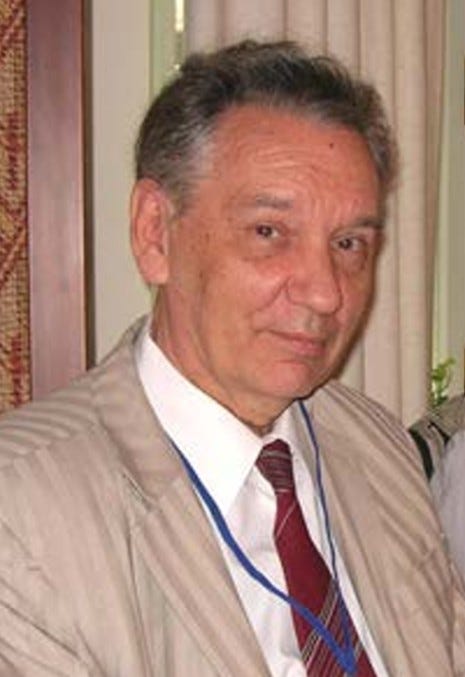
Rikhlyakova was avenged, if you will, by her grandson Vadim, whom she never knew. He had a brilliant career, not in the theatre, but as an engineer, genealogist and writer. And, redirected to Rikhlyakova’s own art, there were her numerous students; among them Lydia Tyuntina, who after a 30-year career with the Kirov Ballet became a well-known teacher herself and … the Russo-western ballerina Alexandra Danilova. Her students in turn represented American ballet, as they filled the ranks of the New York City Ballet. It was Rikhlyakova who had accompanied Danilova’s first steps in the Theatre School and through her, her professional DNA runs through the fabric of ballet in the West too. So, here’s to spotlighting Varvara Rikhlyakova. Aside from pointing out her own accomplishments, doing so helps build the big picture of Petipa’s epoch in the West. She deserves a place in the sun.
© Peter Koppers
Notes
1) The Petersburg Leaflet thought that Zucchi had nothing to worry about: ‘… Miss Zucchi was offered in this scene a chance to flaunt her ‘steel pointes,’ jetés and all the grace of her movements ...’ Then again, ‘steel pointes’ may be how one describes pointe shoe technique cliché-wise. Arguably, Zucchi had a good ‘bourrée,’ but may not have been, for example, a great turner.
2) Kschessinskaya did not feature in Sleeping Beauty’s first act either, she was already second cast to Zhukova for Red Riding Hood.
3) In The Petersburg Noverre, Roland John Wiley ‘solves’ the question whether Minkus actually wrote the score especially for Kalkabrino or that it was assembled from old work (which would have been unusual): he informs us that Minkus ‘would compose one more ballet’ (on the occasion of his farewell benefit in 1886), and that he accompanied Brianza and Petipa in the curtain calls; indicative of a premiere.4) Venus in Bluebeard (1896) was the one future exception, which she may have accepted (or not fought) to be part of Petipa’s big jubilee. Both Cinderella’s Odette and Venus went to Preobrazhenskaya.
5) Ivan Valberg had produced his Bluebeard in 1807.
6) The Imperial Yearbook gives 8 February 1898 as the benefit date, Plescheyev the 15th.
7) When given separately, the first act of Mikado’s Daughter must have ended with the festive 3rd scene; for the act actually ends with a cliff hanger: there is an abductive dragon, smoke, and general confusion.
8) Petipa (probably) created this variation for Maria Gorshenkova in La Vestale, which she also danced in Le Roi Candaule later on. This is not to be confused with the variation Anna Pavlova danced in that ballet, the better known one in C-dur.
9) The friendship between Kschessinskaya and Preobrazhenskaya was artistically sealed on 16 Dec 1907, when Legat’s ballet The Scarlet Flower premiered. Preobrazhenskaya danced the leading role, while Kschessinskaya appeared in a divertissement, ‘Reverie,’ with Legat. She had not done this kind of ‘guesting’ in another ballerina’s ballet since Bluebeard, and that was over a decade ago.
10) Fleur-de Lys is second ballerina-role to Esmeralda – a role in her own right, not a ‘dancing behind role’ (compare: Giselle/Myrthe, Nikiya/Gamzatti). As the Fleur-de-Lys of the revival premiere, it is not so strange that Preobrazhenskaya just wanted to keep on performing it, managing to secure Kschessinskaya’s help there.
11) Kschessinskaya’s relation with Pavlova appears to have been on and off. As can be deduced from Teliakovsky’s diary, it was ‘on’ when Rikhlyakova was in play. Interesting is Kschessinskaya’s call for Pavlova to do Rikhlyakova’s variation. From the first performance of Esmeralda’s 1899 revival, Pavlova was paired with Lubov Petipa, whom Rikhlyakova replaced – meaning Pavlova was not her logical replacer. Since Pavlova and Rikhlyakova appear together as Fleur-de-Lys’s Friends in the Choreographic Notations (in Harvard’s Sergeyev Collection), it means that, at some point, they switched places or one of them did a different variation. Rikhlyakova is listed a few times in the CN, but there is no variation included and merely some sketchy ground plans (free after Doug Fullington). The variations appear to have survived nonetheless: through Julia Sedova’s records and they conform musically to the Gusev/Boyarchikov Maly Esmeralda (albeit it with new choreography), the first is usually attributed to Kalkabrino, the second one now in use for Diana and Acteon (interpolated by Vaganova because she likely danced it as Fleur-de-Lys’s Friend). This still does not shed light on which variation Rikhlyakova danced.
12) Kschessinskaya and Lydia Kyaksht became friends after the latter entered the company. That was not the case early on: in 1897, Lydia Georgievna described how her prank with Indian rubber firecrackers had infuriated Kschessinskaya, who threatened her with expulsion. This happened during The Wedding of Thetis and Peleus, on the occasion of Wilhelm II’s state visit (28 Jul), not during the French President Fauré’s visit, when A Midsummer Night’s Dream was given (11 Aug), as Kyaksht misremembered. She also wrongly recollected that Kschessinskaya was Venus (she was played by Olga Leonova) in whose boat she arrived as a little cupid.
13) Likhosherstova referred to Rikhlyakova’s niece (which is attested by Vadim Rikhlyakov). She was adopted by Rikhlyakova; hence she spoke of Maria Ilyinichna as her daughter. A far less credible theory is that Rikhlyakova gave birth to Maria herself, because that cannot have been before 1902 (her performance record and timeline prior to that does not allow for a pregnancy and birth). This would also entail that she liaised with another man (by the name of Ilya) while being with Tchigaev and that Maria graduated at 15.
14) Kschessinskaya’s official title was ‘Ballerina,’ ‘Prima’ and ‘Assoluta’ being appropriated, or automatically affixed because Legnani had left. Preobrazhenskaya had earned the title in 1900, Pavlova and Trefilova in 1906, Vaganova in 1915 and Julia Sedova in 1916, both close to retirement. Vaganova’s meagre repertoire of principal roles and the interpretative qualities attributed to her and Sedova make their promotion extra peculiar.
15) Teliakovsky let Pavlova break Kschessinskaya’s monopoly on La Bayadere (28 Apr 1902), when the latter was pregnant. Kschessinskaya tried to regain control over the situation by making it known that the decision to let Pavlova dance Nikiya was hers (she had done that with her friend Geltser) and ‘helped her’ (she thought that Anna Matveyevna would be a disaster). Teliakovsky did similar with Pharaoh’s Daughter (29 Jan 1906) when Kschessinskaya wintered in Cannes. See also note 11.
16) Guest addressed this when writing about Perrot: ‘These Russian critics were much more interested in the dramatic content than were the French’ (Jules Perrot, p 247). The story-oriented way of appraisal did not change over the years.
Sources & Selected Bibliography:
Sergey Belenky
Pierre Contal
Andrew Foster
Doug Fullington
Amy Growcott
Alexei Ratmansky
Александр Горский: балетмейстер, художник, фотограф: Фролова, Сабурова, Чуракова
Activities of S. N. Khudekov in the context of the formation of Russian Professional Ballet Criticism in the 2nd half of the 10th-early 20th centuries, Snezhana Tikhonenko
Artists of the Imperial Ballet in the 19th century, Irina Boglacheva
Варвара Рыхлякова в балетах Мариуса Петипа // Вестник Академии русского балета им. А. Я. Вагановой. — СПб., 2009. — № 2 (22). — С. 158—179.
Choura, Alexandra Danilova
Le Corsaire, Bolshoi Ballet programme book
Dancing in Petersburg, Matilda Kschessinska
Diaries, Matilda Kschessinskaya
Diaries, Vladimir Teliakovsky
The Divine Virginia, Ivor Guest
Era of The Russian Ballet, Natalia Roslavleva
Five Ballets from Paris and St Petersburg, Doug Fullington, Marian Smith
Historygradpetra.net
Imperial Yearbooks
The Legat Saga, John Gregory
The Life and Ballets of Lev Ivanov, Roland John Wiley
Marius Petipa, The Emperor’s Ballet Master, Nadine Meisner
Materials on the History of Russian Ballet, vol. II, Mikhail Borisoglebsky
Nash Balet, Alexander Plescheyev
O Balete, Anna Grutsinova
Oxford Reference
Партер и карцер: Воспоминания офицера и театрала, Denis Leshkov
The Petersburg Ballet, Alexander Shiryaev
The Petersburg Noverre, Roland John Wiley
The Petipa Era, Natalia Metelitsa
Petipa Materials
Raymonda, Bolshoi Ballet programme book
Romantic Recollections, Lydia Kyaksht, edited by Erica Beale
Russian Ballet at the Beginning of the 20th Century, Vera Krasovskaya
Русский балетный театр второй половины XIX века, Vera Krasovskaya
Sleeping Beauty, A Legend in Progress, Tim Scholl
Статьи о балете, К. А. Скальковский
The State Theatre Library Museum of St Petersburg
The Story of the Russian School, Nicolai Legat
Theatre Street, Tamara Karsavina
Replique, composed from two 1968 letters, Serge Grigoriev
Writings on Ballet and Music, Fyodor Lopukhov
Photo Credits
A.A. Bakhrushin State Central Theatre Museum, Artchive, Bolshoi Archive, St Petersburg State Museum of Theatre and Music / Санкт-Петербургского государственного музея театрального и музыкального искусства, St Petersburg State Theatre Library / Санкт-Петербургская государственная театральная библиотека, Mariinsky Theatre Archive, Collection of Peter Koppers, Salvador Sasot Sellart